


Page 163 - Handout of Computer Architecture (1)..
P. 163
Another  design  issue  is  the  number  of  registers,  either  general  purpose  or  data  plus  address,  to  be
               provided. Again, this affects instruction set design because more registers require more operand specifier
               bits.

               As we previously discussed, somewhere between 8 and 32 registers appears optimum [LUND77]. Fewer
               registers result in more memory references; more registers do not noticeably reduce memory references
               (e.g., see [WILL90]). However, a new approach, which finds advantage in the use of hundreds of registers,
               is exhibited in some RISC systems and is discussed in Chapter 15. Finally, there is the issue of register
               length. Registers that must hold addresses obviously must be at least long enough to hold the largest
               address. Data registers should be able to hold values of most data types.

               Some machines allow two contiguous registers to be used as one for holding double- length values.

               A final category of registers, which is at least partially visible to the user, holds condition codes (also
               referred to as flags). Condition codes are bits set by the processor hardware as the result of operations.
               For  example,  an  arithmetic  operation  may  produce  a  positive,  negative,  zero,  or  overflow  result.  In
               addition to the result itself being stored in a register or memory, a condition code is also set. The code
               may subsequently be tested as part of a conditional branch operation. Condition code bits are collected
               into one or more registers. Usually, they form part of a control register. Generally, machine instructions
               allow these bits to be read by implicit reference, but the programmer cannot alter them. Many processors,
               including those based on the IA- 64 architecture and the MIPS processors, do not use condition codes at
               all. Rather, conditional branch instructions specify a comparison to be made and act on the result of the
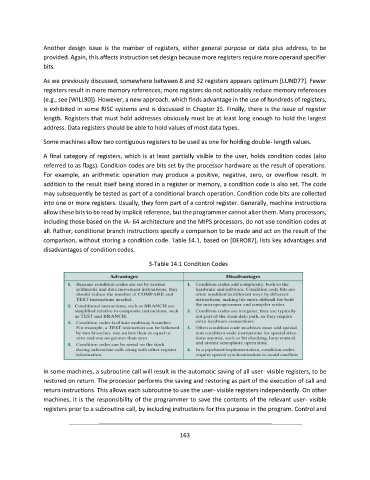
               comparison, without storing a condition code. Table 14.1, based on [DERO87], lists key advantages and
               disadvantages of condition codes.

                                                  3-Table 14.1 Condition Codes


               In some machines, a subroutine call will result in the automatic saving of all user- visible registers, to be
               restored on return. The processor performs the saving and restoring as part of the execution of call and
               return instructions. This allows each subroutine to use the user- visible registers independently. On other
               machines, it is the responsibility of the programmer to save the contents of the relevant user- visible
               registers prior to a subroutine call, by including instructions for this purpose in the program. Control and


                                                             163

