


Page 160 - Handout of Computer Architecture (1)..
P. 160
field also contains a symbolic address. With this last refinement, we have an assembly language. Programs
               written in assembly language (assembly programs) are translated into machine language by an assembler.
               This program must not only do the symbolic translation discussed earlier but also assign some form of
               memory addresses to symbolic addresses. The development of assembly language was a major milestone
               in the evolution of computer technology. It was the first step to the high- level languages in use today.
               Although few programmers use assembly language, virtually all machines provide one. They are used, if
               at all, for systems programs such as compilers and I/O routines. Appendix B provides a more detailed
               examination of assembly language.

               PROCESSOR ORGANIZATION

               To  understand  the  organization  of  the  processor,  let  us  consider  the  requirements  placed  on  the
               processor, the things that it must do:

               ■ Fetch instruction: The processor reads an instruction from memory (register, cache, main memory).
               ■ Interpret instruction: The instruction is decoded to determine what action is required.

               ■ Fetch data: The execution of an instruction may require reading data from memory or an I/O module.
               ■  Process  data:  The  execution  of  an  instruction  may  require  performing  some  arithmetic  or  logical
               operation on data.

               ■ Write data: The results of an execution may require writing data to memory or an I/O module. To do
               these  things,  it  should  be  clear  that  the  processor  needs  to  store  some  data  temporarily.  It  must
               remember the location of the last instruction so that it can know where to get the next instruction. It
               needs to store instructions and data temporarily while an instruction is being executed.

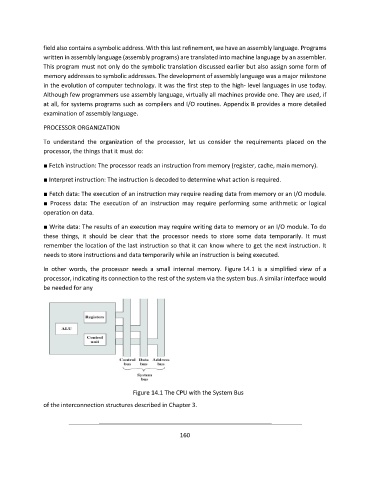
               In  other  words,  the  processor  needs  a  small  internal  memory.  Figure 14.1  is  a  simplified  view  of  a
               processor, indicating its connection to the rest of the system via the system bus. A similar interface would
               be needed for any


                                             Figure 14.1 The CPU with the System Bus

               of the interconnection structures described in Chapter 3.


                                                             160

