


Page 94 - Handout of Computer Architecture (1)..
P. 94
d. Decreasing frequency of access of the memory by the processor.

               Thus, smaller, more expensive, faster memories are supplemented by larger, cheaper, slower memories.
               The key to the success of this organization


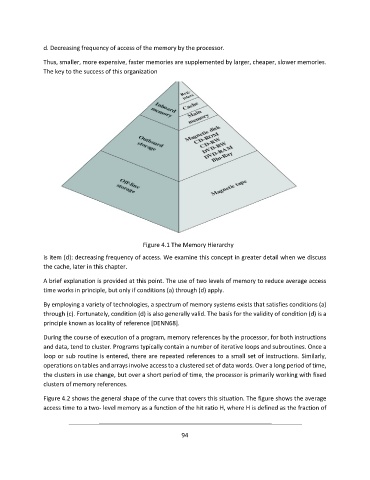
                                                Figure 4.1 The Memory Hierarchy
               is item (d): decreasing frequency of access. We examine this concept in greater detail when we discuss
               the cache, later in this chapter.

               A brief explanation is provided at this point. The use of two levels of memory to reduce average access
               time works in principle, but only if conditions (a) through (d) apply.

               By employing a variety of technologies, a spectrum of memory systems exists that satisfies conditions (a)
               through (c). Fortunately, condition (d) is also generally valid. The basis for the validity of condition (d) is a
               principle known as locality of reference [DENN68].

               During the course of execution of a program, memory references by the processor, for both instructions
               and data, tend to cluster. Programs typically contain a number of iterative loops and subroutines. Once a
               loop or sub routine is entered, there are repeated references to a small set of instructions. Similarly,
               operations on tables and arrays involve access to a clustered set of data words. Over a long period of time,
               the clusters in use change, but over a short period of time, the processor is primarily working with fixed
               clusters of memory references.

               Figure 4.2 shows the general shape of the curve that covers this situation. The figure shows the average
               access time to a two- level memory as a function of the hit ratio H, where H is defined as the fraction of


                                                             94

