


Page 95 - Handout of Computer Architecture (1)..
P. 95
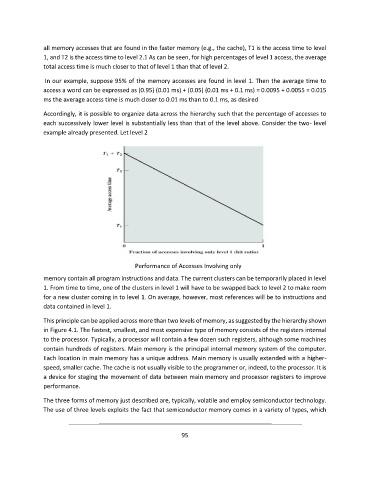
all memory accesses that are found in the faster memory (e.g., the cache), T1 is the access time to level
               1, and T2 is the access time to level 2.1 As can be seen, for high percentages of level 1 access, the average
               total access time is much closer to that of level 1 than that of level 2.

                In our example, suppose 95% of the memory accesses are found in level 1. Then the average time to
               access a word can be expressed as (0.95) (0.01 ms) + (0.05) (0.01 ms + 0.1 ms) = 0.0095 + 0.0055 = 0.015
               ms the average access time is much closer to 0.01 ms than to 0.1 ms, as desired

               Accordingly, it is possible to organize data across the hierarchy such that the percentage of accesses to
               each successively lower level is substantially less than that of the level above. Consider the two- level
               example already presented. Let level 2


                                              Performance of Accesses Involving only

               memory contain all program instructions and data. The current clusters can be temporarily placed in level
               1. From time to time, one of the clusters in level 1 will have to be swapped back to level 2 to make room
               for a new cluster coming in to level 1. On average, however, most references will be to instructions and
               data contained in level 1.


               This principle can be applied across more than two levels of memory, as suggested by the hierarchy shown
               in Figure 4.1. The fastest, smallest, and most expensive type of memory consists of the registers internal
               to the processor. Typically, a processor will contain a few dozen such registers, although some machines
               contain hundreds of registers. Main memory is the principal internal memory system of the computer.
               Each location in main memory has a unique address. Main memory is usually extended with a higher-
               speed, smaller cache. The cache is not usually visible to the programmer or, indeed, to the processor. It is
               a device for staging the movement of data between main memory and processor registers to improve
               performance.

               The three forms of memory just described are, typically, volatile and employ semiconductor technology.
               The use of three levels exploits the fact that semiconductor memory comes in a variety of types, which


                                                             95

