


Page 91 - Handout of Computer Architecture (1)..
P. 91
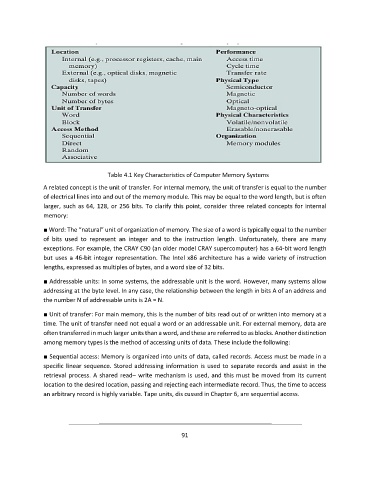
Table 4.1 Key Characteristics of Computer Memory Systems
               A related concept is the unit of transfer. For internal memory, the unit of transfer is equal to the number
               of electrical lines into and out of the memory module. This may be equal to the word length, but is often
               larger, such as 64, 128, or 256 bits. To clarify this point, consider three related concepts for internal
               memory:

               ■ Word: The “natural” unit of organization of memory. The size of a word is typically equal to the number
               of  bits  used  to  represent  an  integer  and  to  the  instruction  length.  Unfortunately,  there  are  many
               exceptions. For example, the CRAY C90 (an older model CRAY supercomputer) has a 64-bit word length
               but  uses  a  46-bit  integer representation.  The  Intel x86  architecture  has  a  wide  variety of  instruction
               lengths, expressed as multiples of bytes, and a word size of 32 bits.

               ■ Addressable units: In some systems, the addressable unit is the word. However, many systems allow
               addressing at the byte level. In any case, the relationship between the length in bits A of an address and
               the number N of addressable units is 2A = N.

               ■ Unit of transfer: For main memory, this is the number of bits read out of or written into memory at a
               time. The unit of transfer need not equal a word or an addressable unit. For external memory, data are
               often transferred in much larger units than a word, and these are referred to as blocks. Another distinction
               among memory types is the method of accessing units of data. These include the following:

               ■ Sequential access: Memory is organized into units of data, called records. Access must be made in a
               specific  linear  sequence.  Stored  addressing  information  is  used to  separate  records  and  assist  in  the
               retrieval process. A shared read– write mechanism is used, and this must be moved from its current
               location to the desired location, passing and rejecting each intermediate record. Thus, the time to access
               an arbitrary record is highly variable. Tape units, dis cussed in Chapter 6, are sequential access.


                                                             91

