


Page 87 - Handout of Computer Architecture (1)..
P. 87
Thus, there must be paths for connecting the modules.

               The collection of paths connecting the various modules is called the interconnection structure. The design
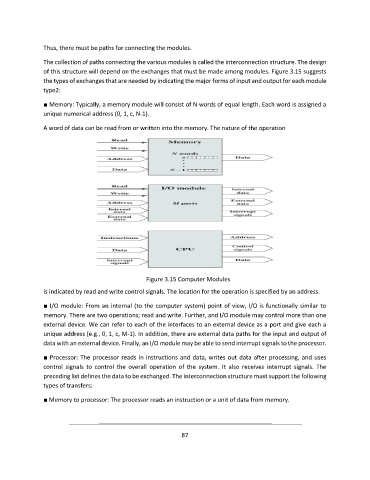
               of this structure will depend on the exchanges that must be made among modules. Figure 3.15 suggests
               the types of exchanges that are needed by indicating the major forms of input and output for each module
               type2:

               ■ Memory: Typically, a memory module will consist of N words of equal length. Each word is assigned a
               unique numerical address (0, 1, c, N-1).

               A word of data can be read from or written into the memory. The nature of the operation


                                                 Figure 3.15 Computer Modules

               is indicated by read and write control signals. The location for the operation is specified by an address.
               ■ I/O module: From an internal (to the computer system) point of view, I/O is functionally similar to
               memory. There are two operations; read and write. Further, and I/O module may control more than one
               external device. We can refer to each of the interfaces to an external device as a port and give each a
               unique address (e.g., 0, 1, c, M-1). In addition, there are external data paths for the input and output of
               data with an external device. Finally, an I/O module may be able to send interrupt signals to the processor.

               ■ Processor: The processor reads in instructions and data, writes out data after processing, and uses
               control  signals  to  control  the  overall  operation  of  the  system.  It  also  receives  interrupt  signals.  The
               preceding list defines the data to be exchanged. The interconnection structure must support the following
               types of transfers:

               ■ Memory to processor: The processor reads an instruction or a unit of data from memory.


                                                             87

