


Page 82 - Handout of Computer Architecture (1)..
P. 82
Extra instructions must be executed (in the interrupt handler) to determine the nature of the interrupt
               and to decide on the appropriate action.

               Nevertheless, because of the relatively large amount of time that would be wasted by simply waiting on
               an I/O operation, the processor can be employed much more efficiently with the use of interrupts.

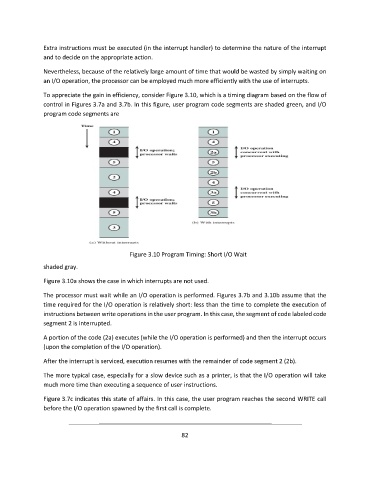
               To appreciate the gain in efficiency, consider Figure 3.10, which is a timing diagram based on the flow of
               control in Figures 3.7a and 3.7b. In this figure, user program code segments are shaded green, and I/O
               program code segments are


                                            Figure 3.10 Program Timing: Short I/O Wait
               shaded gray.

               Figure 3.10a shows the case in which interrupts are not used.

               The processor must wait while an I/O operation is performed. Figures 3.7b and 3.10b assume that the
               time required for the I/O operation is relatively short: less than the time to complete the execution of
               instructions between write operations in the user program. In this case, the segment of code labeled code
               segment 2 is interrupted.

               A portion of the code (2a) executes (while the I/O operation is performed) and then the interrupt occurs
               (upon the completion of the I/O operation).

               After the interrupt is serviced, execution resumes with the remainder of code segment 2 (2b).

               The more typical case, especially for a slow device such as a printer, is that the I/O operation will take
               much more time than executing a sequence of user instructions.

               Figure 3.7c indicates this state of affairs. In this case, the user program reaches the second WRITE call
               before the I/O operation spawned by the first call is complete.


                                                             82

