


Page 83 - Handout of Computer Architecture (1)..
P. 83
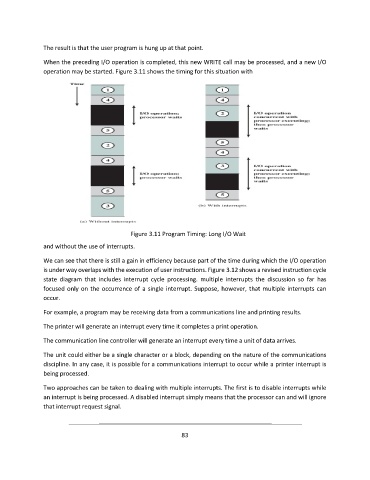
The result is that the user program is hung up at that point.

               When the preceding I/O operation is completed, this new WRITE call may be processed, and a new I/O
               operation may be started. Figure 3.11 shows the timing for this situation with


                                            Figure 3.11 Program Timing: Long I/O Wait
               and without the use of interrupts.

               We can see that there is still a gain in efficiency because part of the time during which the I/O operation
               is under way overlaps with the execution of user instructions. Figure 3.12 shows a revised instruction cycle
               state  diagram  that  includes  interrupt  cycle  processing.  multiple  interrupts  the  discussion  so  far  has
               focused only on the occurrence of a single interrupt. Suppose, however, that multiple interrupts can
               occur.

               For example, a program may be receiving data from a communications line and printing results.

               The printer will generate an interrupt every time it completes a print operation.

               The communication line controller will generate an interrupt every time a unit of data arrives.

               The unit could either be a single character or a block, depending on the nature of the communications
               discipline. In any case, it is possible for a communications interrupt to occur while a printer interrupt is
               being processed.

               Two approaches can be taken to dealing with multiple interrupts. The first is to disable interrupts while
               an interrupt is being processed. A disabled interrupt simply means that the processor can and will ignore
               that interrupt request signal.


                                                             83

