


Page 81 - Handout of Computer Architecture (1)..
P. 81
and the operating system are responsible for suspending the user program and then resuming it at the
               same point.

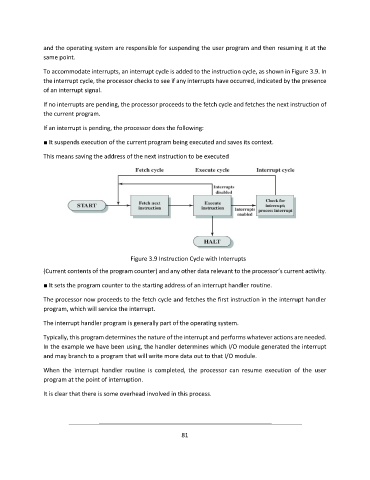
               To accommodate interrupts, an interrupt cycle is added to the instruction cycle, as shown in Figure 3.9. In
               the interrupt cycle, the processor checks to see if any interrupts have occurred, indicated by the presence
               of an interrupt signal.

               If no interrupts are pending, the processor proceeds to the fetch cycle and fetches the next instruction of
               the current program.

               If an interrupt is pending, the processor does the following:

               ■ It suspends execution of the current program being executed and saves its context.

               This means saving the address of the next instruction to be executed


                                            Figure 3.9 Instruction Cycle with Interrupts
               (Current contents of the program counter) and any other data relevant to the processor’s current activity.

               ■ It sets the program counter to the starting address of an interrupt handler routine.

               The processor now proceeds to the fetch cycle and fetches the first instruction in the interrupt handler
               program, which will service the interrupt.

               The interrupt handler program is generally part of the operating system.

               Typically, this program determines the nature of the interrupt and performs whatever actions are needed.
               In the example we have been using, the handler determines which I/O module generated the interrupt
               and may branch to a program that will write more data out to that I/O module.

               When  the  interrupt  handler  routine  is  completed,  the  processor  can  resume  execution  of  the  user
               program at the point of interruption.

               It is clear that there is some overhead involved in this process.


                                                             81

