


Page 99 - Handout of Computer Architecture (1)..
P. 99
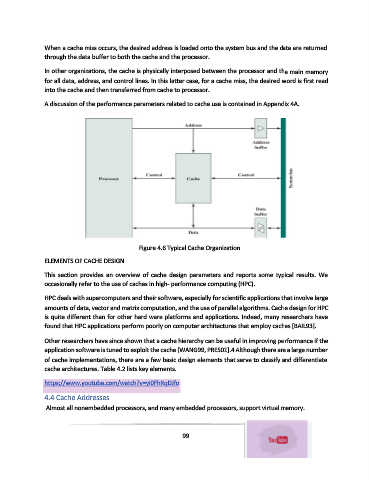
When a cache miss occurs, the desired address is loaded onto the system bus and the data are returned
               through the data buffer to both the cache and the processor.

               In other organizations, the cache is physically interposed between the processor and the main memory
               for all data, address, and control lines. In this latter case, for a cache miss, the desired word is first read
               into the cache and then transferred from cache to processor.

               A discussion of the performance parameters related to cache use is contained in Appendix 4A.


                                               Figure 4.6 Typical Cache Organization
               ELEMENTS OF CACHE DESIGN

               This  section  provides  an  overview  of  cache  design  parameters  and  reports  some  typical  results.  We
               occasionally refer to the use of caches in high- performance computing (HPC).

               HPC deals with supercomputers and their software, especially for scientific applications that involve large
               amounts of data, vector and matrix computation, and the use of parallel algorithms. Cache design for HPC
               is quite different than for other hard ware platforms and applications. Indeed, many researchers have
               found that HPC applications perform poorly on computer architectures that employ caches [BAIL93].


               Other researchers have since shown that a cache hierarchy can be useful in improving performance if the
               application software is tuned to exploit the cache [WANG99, PRES01].4 Although there are a large number
               of cache implementations, there are a few basic design elements that serve to classify and differentiate
               cache architectures. Table 4.2 lists key elements.
               https://www.youtube.com/watch?v=yi0FhRqDJfo

               4.4 Cache Addresses

                Almost all nonembedded processors, and many embedded processors, support virtual memory.


                                                             99

