


Page 179 - Candi Indonesia (Jawa)
P. 179
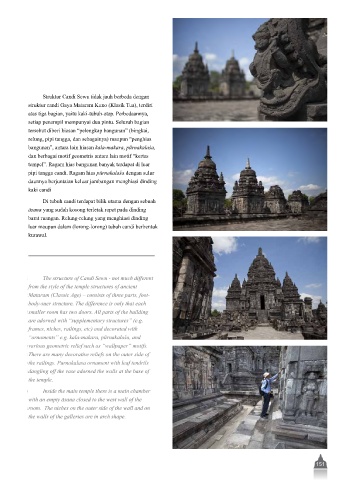
Struktur Candi Sewu tidak jauh berbeda dengan
            struktur candi Gaya Mataram Kuno (Klasik Tua), terdiri
            atas tiga bagian, yaitu kaki-tubuh-atap. Perbedaannya,
            setiap penampil mempunyai dua pintu. Seluruh bagian
            tersebut diberi hiasan “pelengkap bangunan” (bingkai,
            relung, pipi tangga, dan sebagainya) maupun “penghias
            bangunan”, antara lain hiasan NDOD PDNDUD, SnjUQDNDODĞD
            dan berbagai motif geometris antara lain motif “kertas
            tempel”. Ragam hias bangunan banyak terdapat di luar
            pipi tangga candi. Ragam hias SnjUQDNDODĞD dengan sulur
            daunnya berjuntaian keluar jambangan menghiasi dinding

            kaki candi
                  Di tubuh candi terdapat bilik utama dengan sebuah
            ƗVDQD yang sudah kosong terletak rapat pada dinding
            barat ruangan. Relung-relung yang menghiasi dinding
            luar maupun dalam (lorong-lorong) tubuh candi berbentuk
            kurawal.


                  The structure of Candi Sewu - not much different
            from the style of the temple structures of ancient
            Mataram (Classic Age) – consists of three parts, foot-
            body-suer structure. The difference is only that each
            smaller room has two doors. All parts of the building
            are adorned with “supplementary structures” (e.g.
            frames, niches, railings, etc) and decorated with
            ³RUQDPHQWV´ H J  NDOD PDNDUD  SnjUQDNDODĞD  DQG
            various geometric relief such as “wallpaper” motifs.

            There are many decorative reliefs on the outer side of
            the railings. Purnakalasa ornament with leaf tendrils
            dangling off the vase adorned the walls at the base of
            the temple.
                  Inside the main temple there is a main chamber
            ZLWK DQ HPSW\ ƗVDQD FORVHG WR WKH ZHVW ZDOO RI WKH

            room.  The niches on the outer side of the wall and on
            the walls of the galleries are in arch shape.


                                                                                                                            151

