


Page 292 - Candi Indonesia (Jawa)
P. 292
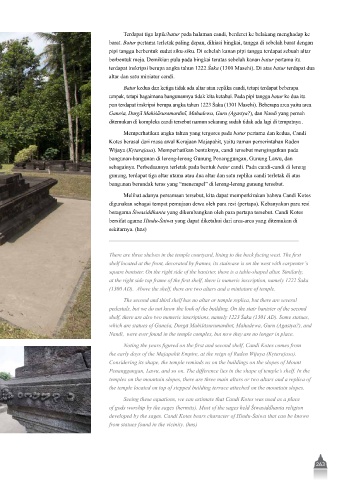
Terdapat tiga lapik/batur pada halaman candi, berderet ke belakang menghadap ke
                                            barat. Batur pertama terletak paling depan, dihiasi bingkai, tangga di sebelah barat dengan
                                            pipi tangga berbentuk sudut siku-siku. Di sebelah kanan pipi tangga terdapat sebuah altar
                                            berbentuk meja. Demikian pula pada bingkai teratas sebelah kanan batur pertama itu
                                            terdapat inskripsi berupa angka tahun 1222 ĝDND (1300 Masehi). Di atas batur terdapat dua
                                            altar dan satu miniatur candi.

                                                 Batur kedua dan ketiga tidak ada altar atau replika candi, tetapi terdapat beberapa
                                            umpak, tetapi bagaimana bangunannya tidak kita ketahui. Pada pipi tangga batur ke dua itu
                                            SXQ WHUGDSDW LQVNULSVL EHUXSD DQJND WDKXQ      ĝDND       0DVHKL   %HEHUDSD DUFD \DLWX DUFD
                                            *DQHĞD  'XUJƗ 0DKLĞƗVXUDPDUGLQƯ  0DKDGHZD  *XUX  $JDVW\D"), dan Nandi yang pernah
                                            ditemukan di kompleks candi tersebut namun sekarang sudah tidak ada lagi di tempatnya .

                                                 Memperhatikan angka tahun yang tergores pada batur pertama dan kedua, Candi
                                            .RWHV EHUDVDO GDUL PDVD DZDO .HUDMDDQ 0DMDSDKLW  \DLWX ]DPDQ SHPHULQWDKDQ 5DGHQ
                                            Wijaya (.܀WDUDMDVD). Memperhatikan bentuknya, candi tersebut mengingatkan pada
                                            bangunan-bangunan di lereng-lereng Gunung Penanggungan, Gunung Lawu, dan
                                            sebagainya. Perbedaannya terletak pada bentuk batur candi. Pada candi-candi di lereng
                                            gunung, terdapat tiga altar utama atau dua altar dan satu replika candi terletak di atas
                                            bangunan berundak teras yang “menempel” di lereng-lereng gunung tersebut.

                                                 Melihat adanya persamaan tersebut, kita dapat memperkirakan bahwa Candi Kotes
                                            digunakan sebagai tempat pemujaan dewa oleh para resi (pertapa). Kebanyakan para resi
                                            beragama ĝLZDVLGGKDQWD yang dikembangkan oleh para pertapa tersebut. Candi Kotes
                                            bersifat agama +LQGX ĝDLZD yang dapat diketahui dari arca-arca yang ditemukan di
                                            sekitarnya. (hns)


                                            7KHUH DUH WKUHH VKHOYHV LQ WKH WHPSOH FRXUW\DUG  OLQLQJ WR WKH EDFN IDFLQJ ZHVW  7KH ¿UVW
                                            shelf located at the front, decorated by frames, its staircase is on the west with carpenter’s
                                            square banister. On the right side of the banister, there is a table-shaped altar. Similarly,

                                            DW WKH ULJKW VLGH WRS IUDPH RI WKH ¿UVW VKHOI  WKHUH LV QXPHULF LQVFULSWLRQ  QDPHO\      ĝDND
                                                  $'    $ERYH WKH VKHOI  WKHUH DUH WZR DOWDUV DQG D PLQLDWXUH RI WHPSOH
                                                 The second and third shelf has no altar or temple replica, but there are several
                                            pedestals, but we do not know the look of the building. On the stair banister of the second
                                            VKHOI  WKHUH DUH DOVR WZR QXPHULF LQVFULSWLRQV  QDPHO\      ĝDND       $'   6RPH VWDWXHV
                                            ZKLFK DUH VWDWXHV RI *DQHĞD  'XUJƗ 0DKLĞƗVXUDPDUGLQƯ  0DKDGHZD  *XUX  $JDVW\D"   DQG
                                            Nandi,  were ever found in the temple complex, but now they are no longer in place.

                                                 1RWLQJ WKH \HDUV ¿JXUHG RQ WKH ¿UVW DQG VHFRQG VKHOI  &DQGL .RWHV FRPHV IURP
                                            WKH HDUO\ GD\V RI WKH 0DMDSDKLW (PSLUH  DW WKH UHLJQ RI 5DGHQ :LMD\D  .܀WDUDMDVD

                                            &RQVLGHULQJ LWV VKDSH  WKH WHPSOH UHPLQGV XV RQ WKH EXLOGLQJV RQ WKH VORSHV RI 0RXQW
                                            Penanggungan, Lawu, and so on. The difference lies in the shape of temple’s shelf. In the
                                            temples on the mountain slopes, there are three main altars or two altars and a replica of
                                            the temple located on top of stepped building terrace attached on the mountain slopes.
                                                 6HHLQJ WKHVH HTXDWLRQV  ZH FDQ HVWLPDWH WKDW &DQGL .RWHV ZDV XVHG DV D SODFH
                                            RI JRGV ZRUVKLS E\ WKH VDJHV  KHUPLWV   0RVW RI WKH VDJHV KHOG ĝLZDVLGGKDQWD UHOLJLRQ
                                            GHYHORSHG E\ WKH VDJHV  &DQGL .RWHV EHDUV FKDUDFWHU RI +LQGX ĝDLZD WKDW FDQ EH NQRZQ

                                            IURP VWDWXHV IRXQG LQ WKH YLFLQLW\   KQV


                                                                                                                            263

