


Page 308 - Candi Indonesia (Jawa)
P. 308
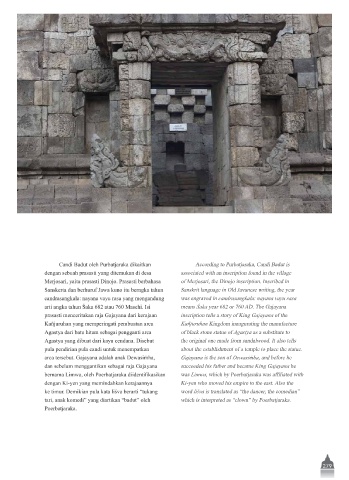
Candi Badut oleh Purbatjaraka dikaitkan              According to Purbatjaraka, Candi Badut is
                  dengan sebuah prasasti yang ditemukan di desa         associated with an inscription found in the village
                  Merjosari, yaitu prasasti Dinojo. Prasasti berbahasa   of Merjosari, the Dinojo inscription. Inscribed in
                  Sanskerta dan berhuruf Jawa kuno itu berngka tahun    Sanskrit language in Old Javanese writing, the year
                  candrasangkala: nayana vayu rasa yang mengandung      was engraved in FDQGUDVDQJNDOD: QD\DQD YD\X UDVD
                  DUWL DQJND WDKXQ ĝDND     DWDX     0DVHKL  ,VL        means ĝDND year 682 or 760 AD. The Gajayana
                  prasasti menceritakan raja Gajayana dari kerajaan     inscription tells a story of King *DMD\DQD of the
                  Kañjuruhan yang memperingati pembuatan arca           .DxMXUXKDQ Kingdom inaugurating the manufacture
                  Agastya dari batu hitam sebagai pengganti arca        of black stone statue of $JDVW\D as a substitute to
                  Agastya yang dibuat dari kayu cendana. Disebut        the original one made   from sandalwood. It also tells
                  pula pendirian pula candi untuk menempatkan           about the establishment of a temple to place the statue.
                  DUFD WHUVHEXW  *DMD\DQD DGDODK DQDN 'HZDVLীKD         *DMD\DQD is the son of 'HZDVLۦKD, and before he
                  dan sebelum menggantikan sebagai raja Gajayana        succeeded his father and became King *DMD\DQD he
                  EHUQDPD /LPZD  ROHK 3RHUEDWMDUDND GLLGHQWL¿NDVLNDQ    was /LPZD  ZKLFK E\ 3RHUEDWMDUDND ZDV DI¿OLDWHG ZLWK
                  dengan Ki-yen yang memindahkan kerajaannya            Ki-yen who moved his empire to the east. Also the
                  NH WLPXU  'HPLNLDQ SXOD NDWD OLĞYD EHUDUWL ³WXNDQJ   word OLĞYD is translated as “the dancer, the comedian”

                  WDUL  DQDN NRPHGL´ \DQJ GLDUWLNDQ ³EDGXW´ ROHK       which is interpreted as “clown” by Poerbatjaraka.
                  Poerbatjaraka.


                                                                                                                               279

