


Page 39 - 2015 Best Practices of Spectacle Lens Management
P. 39
Best Practices    8. Train staff to eliminate incorrect measurements and  10. Conduct ongoing patient satisfaction surveys.
                          lens specifications.  Go to ecpuniversity.com for staff training   Provide each patient with a stamped, addressed postcard to complete
                continued
                          content on lens measurement techniques.        and return to the practice, evaluating their visit and their satisfaction
                                                                         with eyewear purchased. Leave space for patients to write in comments
                          9. Call buyers of new spectacle lenses one week after   and suggestions. At regular staff meetings, review patient feedback, and
                          delivery to determine satisfaction. After a patient purchases   brainstorm process changes to address complaints and dissatisfactions.
                          a type of spectacle lens not previously worn, call the patient seven
                          days after product delivery to determine his or her satisfaction with  11. Visit  yelp.com, checkbook.com and other retail
                          the new device and answer any questions. The doctor should make  satisfaction web sites to see what patients say about
                          some of these calls. An unexpected follow-up call sends a strong  your service. These web sites can reveal issues that patients may
                          signal that patient satisfaction is important to the practice and   never tell the practice about directly. A few patients will never be
                          keeps the office in touch with how patients experience the products   satisfied, but if consistently negative themes are noted in patient blogs,
                          you recommend.                                 there is a basis for remedial action.


                           Adopting Best Practices

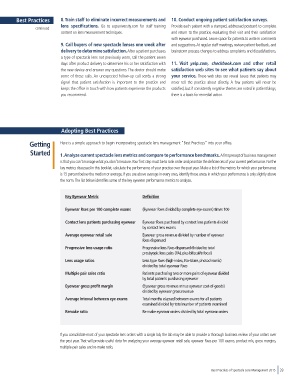
             Getting      Here is a simple approach to begin incorporating spectacle lens management “Best Practices” into your office.

              Started     1. Analyze current spectacle lens metrics and compare to performance benchmarks. A first precept of business management
                          is that you can’t manage what you don’t measure. Your first step must be to rank order and prioritize the deficiencies of your current performance. For the
                          key metrics discussed in this booklet, calculate the performance of your practice over the past year. Make a list of the metrics for which your performance
                          is 15 percent below the median or average. If you are above average in every area, identify those areas in which your performance is only slightly above
                          the norm. The list below identifies some of the key eyewear performance metrics to analyze.


                            Key Eyewear Metric               Definition


                            Eyewear Rxes per 100 complete exams  (Eyewear Rxes divided by complete eye exams) times 100

                            Contact lens patients purchasing eyewear  Eyewear Rxes purchased by contact lens patients divided
                                                             by contact lens exams
                            Average eyewear retail sale      Eyewear gross revenue divided by number of eyewear
                                                             Rxes dispensed
                            Progressive lens usage ratio     Progressive lens Rxes dispensed divided by total
                                                             presbyopic lens pairs (PAL plus bifocal/trifocal)
                            Lens usage ratios                Lens type Rxes (high-index, No-Glare, photochromic)
                                                             divided by total eyewear Rxes
                            Multiple pair sales ratio        Patients purchasing two or more pairs of eyewear divided
                                                             by total patients purchasing eyewear
                            Eyewear gross profit margin      (Eyewear gross revenue minus eyewear cost-of-goods)
                                                             divided by eyewear gross revenue
                            Average interval between eye exams  Total months elapsed between exams for all patients
                                                             examined divided by total number of patients examined
                            Remake ratio                     Re-make eyewear orders divided by total eyewear orders


                          If you consolidate most of your spectacle lens orders with a single lab, the lab may be able to provide a thorough business review of your orders over
                          the past year. That will provide useful data for analyzing your average eyewear retail sale, eyewear Rxes per 100 exams, product mix, gross margins,
                          multiple-pair sales and re-make ratio.


                                                                                         Best Practices of Spectacle Lens Management 2015  39

