


Page 35 - 2015 Best Practices of Spectacle Lens Management
P. 35
Best Practices      • Offer catered food and beverages. This makes the event festive,  9. Measure eye exam and eyewear purchase intervals.
                            will draw attendance and is a way to thank patients for their   Practice management software systems may provide an easy way to
                continued   past support.                               capture this information for your entire patient base. But if it does not,
                            • Do not conduct eye exams during the event. The doctor and staff   a simple method to measure the average interval between patient eye
                            should mingle with guests during the event.  exams is to have the receptionist keep a log showing names of patients
                            • Put the expertise of frame sales reps to work to present styles to   about to receive eye exams. Next to each name record the number of
                            event guests.                               elapsed months since their last exam, derived from the patient file. At
                            • Offer discounts to encourage sales during the event.  the end of the month, tally the number of elapsed months recorded on
                                                                        the log and divide by the number of patients. A similar approach can
                          8. In October, conduct a mailing to patients with vision   be used to manually calculate the interval between eyewear purchases.
                          insurance, encouraging them to use annual allowances.   Monitor these statistics monthly. They are excellent indicators of the
                          Reminding patients to update their eyeglasses, who have not taken   effectiveness of your recall program and your eyewear presentation
                          advantage of their vision insurance allowances during the current year,   techniques.
                          will cause some to call the office and schedule an appointment.

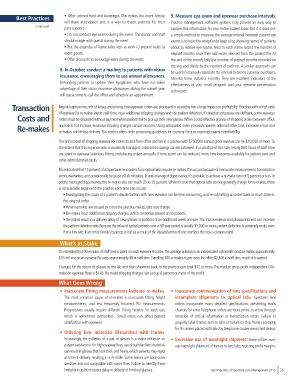
      Transaction         Beyond capture rate, mix of lenses and pricing, how eyewear orders are processed in a practice has a large impact on profitability. Practices with a high ratio

        Costs and         of eyewear Rx re-makes waste staff time, incur additional shipping charges and risk patient defection. If collection processes are deficient, some eyewear
                          orders must be discarded without payment when patients fail to pick up their new glasses. When a cost-effective process of shipping orders between office
        Re-makes          and lab is not in place, excessive shipping charges can be incurred. Using antiquated order processes wastes administrative time, increases errors and
                          re-makes and delays delivery. This section offers order processing guidelines for eyewear Rxes to maximize practice profitability.
                          The annual cost of shipping eyewear Rx orders to and from office and lab in a practice with $750,000 annual gross revenue can be $10,000 or more. To
                          the extent that this expense area is prudently managed, substantial savings can be achieved. In a practice of this size, nearly 800 hours of staff time
                          are spent in eyewear selection, fitting and placing orders annually. If time spent can be reduced, more time becomes available for patient care and
                          other administrative tasks.

                          It’s estimated that 15 percent of all spectacle lens orders from optical labs require re-makes. This occurs because of inaccurate measurements, transcription
                          errors, warranties and,occasionally, because of lab mistakes. In well-managed dispensaries, it’s possible to achieve a re-make ratio of 5 percent or less. In
                          poorly managed dispensaries, the re-make ratio can reach 20 to 25 percent. While it’s true that optical labs do not generally charge for re-makes, there
                          is considerable expense to the practice each time one occurs:
                           • Investigating the cause of a patient’s dissatisfaction with new eyewear can be time-consuming, and re-submitting an order takes as much time as
                           the  original order.
                           • When remakes are caused by errors the practice makes, labs may charge.
                           • Re-makes incur additional shipping charges, which cannot be passed on to patients.
                           • Re-makes result in a delivery delay of new glasses to patients of an additional week or more. This inconvenience and disappointment can increase
                           the patient defection ratio. Because the value of typical patients over a 30-year period is usually $5,000 or more, patient defection is extremely costly, even
                           if at a low rate. If an entire family’s business is lost as a result of the dissatisfaction of one member, the loss is compounded.
                          What’s at Stake

                          It’s estimated that 30 minutes of staff time is spent on each eyewear Rx order. The average optician in an independent optometric practice makes approximately
                          $16 an hour, so an eyewear Rx costs approximately $8 of staff time. Handling 300 re-makes a year costs the office $2,400 in staff time, much of it wasted.

                          Charges for the return of glasses to the lab and then shipment back to the practice can total $12 or more. The median gross profit independent ODs
                          make on eyewear Rxes is $143. Re-make shipping charges can eat up 8 percent or more of the profit.

                          What Goes Wrong
                          •  Inaccurate fitting measurements increase re-makes.  •  Inaccurate communication of lens specifications and
                            The most common cause of re-makes is inaccurate fitting height   incomplete shipments to optical labs.  Spectacle  lens
                            measurements,  and  less  frequently  incorrect  PD  measurements.   orders incorporate many detailed specifications, presenting many
                            Progressives usually require different fitting heights for each eye,   chances for error. Telephone orders are more prone to errors through
                            which is sometimes overlooked.  Small errors can affect patient   omission of critical information or transcription errors. Failure to
                            satisfaction with eyewear.                    properly label frames sent to labs or failure to ship frames promptly
                                                                          for Rx orders placed with labs by telephone causes errors and delays.
                          •  Ordering lens materials ill-matched with frames.
                            Increasingly, the esthetics of a pair of glasses is a major influence on   •   Excessive use of overnight shipment. Some offices over-
                            patient satisfaction. For higher-power Rxes, use of standard lens materials   use overnight shipment of frames to lens labs, reducing profit margins.
                            can result in glasses that look thick and heavy, which patients may reject
                            at time of delivery, resulting in a re-make. Some frames are base-curve
                            sensitive and not compatible with some Rxes. Failure to identify these
                            limitations up-front causes delay in delivery of finished glasses.  Best Practices of Spectacle Lens Management 2015  35

