


Page 30 - 2015 Best Practices of Spectacle Lens Management
P. 30
• Mark-ups are inconsistently applied.  Analyses show   launched. If wholesale costs are not regularly monitored and
                              that ECPs are sometimes inconsistent in the margins they accept   prices not adjusted immediately as increases occur, profit margins
                              for different types of lenses and frames. This occurs in the absence   are eroded.
                              of a defined process to set retail prices, based on gross profit
                              margin targets.                            • Profit margins below 50 percent are accepted.
                                                                           Twenty percent of practices achieve eyewear profit margins below
                            • Lab price changes are not monitored, and retail   50 percent. It is not known if these practices have consciously
                              prices are not immediately adjusted following   established prices to achieve this margin or simply do not know
                              price increases.  While optical lab price increases are   what their profit margin is.
                              infrequent, they still occur, particularly as improved products are
                           Best Practices  To Establish Retail Pricing

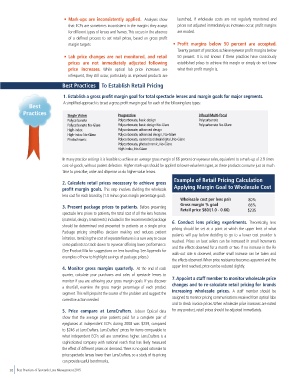
                           1. Establish a gross profit margin goal for total spectacle lenses and margin goals for major segments.
                           A simplified approach is to set a gross profit margin goal for each of the following lens types:
             Best
           Practices         Single Vision        Progressive                       Bifocal/Multi-focal
                             Polycarbonate        Polycarbonate, basic design       Polycarbonate
                             Polycarbonate No-Glare  Polycarbonate, basic design No-Glare  Polycarbonate No-Glare
                             High-index           Polycarbonate, advanced design
                             High-index No-Glare  Polycarbonate, advanced design, No-Glare
                             Photochromic         Polycarbonate, customized dual digital, No-Glare
                                                  Polycarbonate, photochromic, No-Glare
                                                  High index, No-Glare

                           In many practice settings it is feasible to achieve an average gross margin of 66 percent on eyewear sales, equivalent to a mark-up of 2.9 times
                           cost-of-goods, without patient defection. Higher mark-ups should be applied to lower-value lens types, as these products consume just as much
                           time to prescribe, order and dispense as do higher-value lenses.
                                                                          Example of Retail Pricing Calculation
                           2. Calculate retail prices necessary to achieve gross
                           profit margin goals. This step involves dividing the wholesale   Applying Margin Goal to Wholesale Cost
                           lens cost for each brand by (1.0 minus gross margin percentage goal).
                                                                            Wholesale cost per lens pair  80%
                                                                            Gross margin % goal          66%
                           3. Present package prices to patients. Before presenting   Retail price $80/(1.0 - 0.66)
                           spectacle lens prices to patients, the total cost of all the lens features    $235
                           (material, design, treatments) included in the recommended package   6. Conduct lens pricing  experiments.  Theoretically, lens
                           should be determined and presented to patients as a single price.   pricing should be set at a point at which the upper limit of what
                           Package  pricing  simplifies  decision  making  and  reduces  patient   patients will pay before deciding to go to a lower cost provider is
                           irritation. Itemizing the cost of separate features is a sure way to cause   reached. Prices on best sellers can be increased in small increments
                           some patients to trade down to eyewear offering lower performance.   and the effects observed for a month or two. If no increase in the Rx
                           (See Product Mix for suggestions on lens bundling. See Appendix for   walk-out rate is observed, another small increase can be taken and
                           examples of how to highlight savings of package prices.)
                                                                         the effects observed. When price resistance becomes apparent and the
                                                                         upper limit reached, price can be reduced slightly.
                           4. Monitor gross margins quarterly.  At the end of each
                           quarter,  calculate  your  purchases  and  sales  of  spectacle  lenses  to
                           monitor if you are achieving your gross margin goals. If you discover   7. Appoint a staff member to monitor wholesale price
                           a shortfall, examine the gross margin percentage of each product   changes and to re-calculate retail pricing for brands
                           segment. This will pinpoint the source of the problem and suggest the   increasing wholesale prices.  A staff member should be
                           corrective action needed.                     assigned to monitor pricing communications received from optical labs
                                                                         and to check invoice prices. When wholesale price increases are noted
                           5. Price compare at LensCrafters.  Jobson  Optical  data   for any product, retail prices should be adjusted immediately.
                           show that the average price patients paid for a complete pair of
                           eyeglasses at independent ECPs during 2008 was $239, compared
                           to $246 at LensCrafters. LensCrafters’ prices for items comparable to
                           what independent ECPs sell are sometimes higher. LensCrafters is a
                           sophisticated company with national reach that has likely measured
                           the effect of different prices on demand. There is no good rationale to
                           price spectacle lenses lower than LensCrafters, so a study of its pricing
                           can provide useful benchmarks.

     30  Best Practices of Spectacle Lens Management 2015

