


Page 25 - 2015 Best Practices of Spectacle Lens Management
P. 25
What Goes Wrong


                          •  No effort to discover individual patient vision needs    vision insurance covers only one pair of eyeglasses, that’s all the patient
                           While lifestyle dispensing is a well-understood concept, it is frequently   will want. Or they make the false assumption that patients’ eyewear
                           omitted in the busy office visit routine. In the absence of detailed   budgets are so limited as to not allow for purchase of additional
                           information about a patient’s daily activities, it is impossible to   pairs, which would eliminate the compromises that patients endure
                           recommend the ideal lens solutions. In some offices details about   when they use a single pair of glasses for every task in every visual
                           patients’ lifestyles, hobbies and vision problems are collected on a   environment.
                           questionnaire, but then never reviewed by the doctor and staff who
                           assist patients with lens selection.          •  No linkage of lens recommendations and individual
                                                                          needs When lens decisions are made by presenting patients with
                          •  No discussion of benefits of multiple pairs  Trying to avoid   a list of options at different price points, then decisions are made
                           any display of excessive salesmanship, many offices never suggest   based on cost, not on the package of benefits different lenses provide
                           second pairs of eyewear. They may assume that because a patient’s   individual patients.

                         Best Practices To Profile Patient Needs


                          1. Profile each patient’s eyewear needs. A standard process is recommended. Dr. Gailmard likes to ask each patient six questions to
                          identify his or her eyewear needs:
            Best          1. May I ask your occupation?
          Practices       2. Do you have any hobbies?
                          3. Do you participate in outdoor activities?
                          4. Do you use a computer?
                          5. Do you drive long distances?
                          6. Do you like to watch TV?
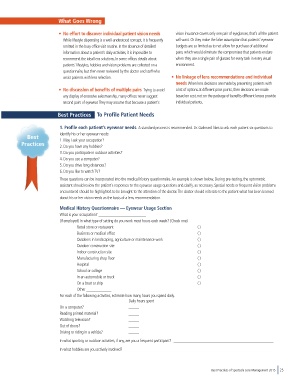
                          These questions can be incorporated into the medical history questionnaire. An example is shown below. During pre-testing, the optometric
                          assistant should review the patient’s responses to the eyewear usage questions and clarify, as necessary. Special needs or frequent vision problems
                          encountered should be highlighted to be brought to the attention of the doctor. The doctor should reiterate to the patient what has been learned
                          about his or her vision needs as the basis of a lens recommendation.

                          Medical History Questionnaire — Eyewear Usage Section
                          What is your occupation? _______________________
                          (If employed) In what type of setting do you work most hours each week? (Check one)
                                 Retail store or restaurant                         ( )
                                 Business or medical office                         ( )
                                 Outdoors in landscaping, agriculture or maintenance work       ( )
                                 Outdoor construction site                          ( )
                                 Indoor construction site                           ( )
                                 Manufacturing shop floor                           ( )
                                 Hospital                                           ( )
                                 School or college                                  ( )
                                 In an automobile or truck                          ( )
                                 On a boat or ship                                  ( )
                                 Other ____________
                          For each of the following activities, estimate how many hours you spend daily.
                                                       Daily hours spent
                          On a computer?               _____
                          Reading printed material?      _____
                          Watching television?         _____
 Annual Eyeglasses Sales
                          Out of doors?                _____
                          Driving or riding in a vehicle?      _____
                          In what sporting or outdoor activities, if any, are you a frequent participant?
                          In what hobbies are you actively involved?


                                                                                         Best Practices of Spectacle Lens Management 2015  25

