


Page 23 - 2015 Best Practices of Spectacle Lens Management
P. 23
Patient      Leisure activities also define    Time Spent Watching Television by Age: 2011
                         vision needs.
          Profiling      U.S. adults spend more than five hours each day      Hours per day        Weekday % of
                                                                                                   Leisure Time
         and Lens        engaged in a variety of leisure activities. Some of these   Age  Weekdays  Weekends  Watching TV
                         activities require different eyewear solutions than are
     Recommen-           dictated by the work setting of individual patients.   15-19  1.95  2.69     35%
                                                            20-24
                                                                                          2.40
                                                                           2.17
                                                                                                      45%
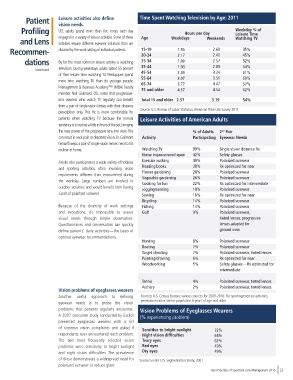
           dations       By far the most common leisure activity is watching   25-34  1.89  2.57      52%
                continued  television. During weekdays, adults spend 55 percent   35-44  1.93  2.89   54%
                                                                                          3.24
                                                            45-54
                         of their leisure time watching TV. Presbyopes spend   2.49                   61%
                         more time watching TV than do younger people.   55-64  3.07      3.51        60%
                                                            65-74
                                                                                          4.47
                         Management & Business Academy™ (MBA) faculty   75 and older  3.77  4.54      57%
                                                                           4.37
                                                                                                      62%
                         member Neil Gailmard, OD, notes that progressive-
                         lens wearers who watch TV regularly can benefit   Total 15 and older 2.57                   3.19                54%
                         from a pair of single-vision lenses with their distance
                         prescription only.  This Rx is more comfortable for   Source: U.S. Bureau of Labor Statistics, American Time Use Survey 2011
                         patients when watching  TV because the normal   Leisure Activities of American Adults
                         tendency is to recline a little in front of the set, bringing
                         the near power of the progressive lens into view. This      % of Adults   2  Pair
                                                                                              nd
                         can result in neck pain or distorted vision. Dr. Gailmard   Activity   Participating  Eyewear Needs
                         himself keeps a pair of single-vision lenses next to his
                         recliner at home.                  Watching TV           99%        Single vision distance Rx
                                                            Home improvement/repair   42%    Safety glasses
                         Adults also participate in a wide variety of hobbies   Exercise walking   40%   Polarized sunwear
                         and sporting activities, often involving vision   Reading books   38%   Rx optimized for near
                         requirements different than encountered during   Flower gardening   28%   Polarized sunwear
                                                                                             Polarized sunwear
                                                                                  26%
                                                            Vegetable gardening
                         the workday. Large numbers are involved in   Cooking for fun   22%   Rx optimized for intermediate
                         outdoor activities and would benefit from having   Jogging/running   18%   Polarized sunwear
                         a pair of polarized sunwear.       Sewing                16%        Rx optimized for near
                                                            Bicycling             14%        Polarized sunwear
                         Because of the diversity of work settings   Fishing      14%        Polarized sunwear
                         and avocations, it’s impossible to assess   Golf         9%         Polarized sunwear,
                         visual needs through simple observation.                            tinted lenses, progressive
                         Questionnaires and conversation can quickly                         lenses adapted for
                         define patients’ daily activities—the basis of                      ground view
                         optimal eyewear recommendations.
                                                            Hunting               8%         Polarized sunwear
                                                            Boating               7%         Polarized sunwear
                                                            Target shooting       7%         Polarized sunwear, tinted lenses
                                                            Painting/drawing      6%         Rx optimized for near
                                                            Woodworking           5%         Safety glasses -- Rx optimized for
                                                                                             intermediate

                                                            Tennis                4%         Polarized sunwear, tinted lenses
                                                            Archery               2%         Polarized sunwear, tinted lenses
                         Vision problems of eyeglasses wearers
                         Another useful approach to defining   Sources: U.S. Census Bureau; various sources for 2009-2010. For sporting/exercise activities,
                                                            penetration ratios are for population 6 years of age and older
                         eyewear needs is to probe the vision
                         problems  that  patients  regularly  encounter.   Vision Problems of Eyeglasses Wearers
                         A 2007 consumer study conducted by Essilor   (% experiencing problem)
                         presented eyeglasses wearers with a list
                         of common vision complaints and asked if   Sensitive to bright sunlight  72%
                         respondents ever encountered each problem.   Night vision difficulties  64%
                         The two most frequently selected vision   Teary eyes              62%
                         problems were sensitivity to bright sunlight   Red eyes           49%
                         and night vision difficulties.  The prevalence   Dry eyes         49%
                         of these demonstrates a widespread need for   Source: Essilor U.S. Segmentation Study, 2007
                         polarized sunwear to reduce glare.
                                                                                         Best Practices of Spectacle Lens Management 2015  23

