


Page 21 - 2015 Best Practices of Spectacle Lens Management
P. 21
Best Practices   9. Reach a decision about the spectacle lens before  11. Track and analyze the spectacle lens sales mix. At
                         frame selection begins. Although the appearance of a pair of   the end of each quarter, the mix of spectacle Rxes dispensed by the
                continued
                         eyeglasses is very important to patients and engages their emotions,   practice should be analyzed and reviewed with the staff, including the
                         the functional attributes and benefits of the lenses have greater impact   following lens categories:
                         on quality of vision, comfort and safety. When a decision about lenses is
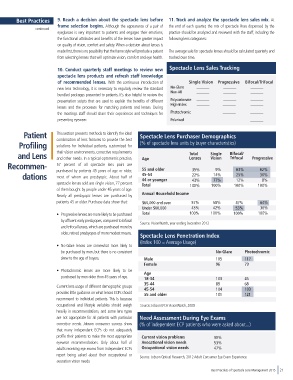
                         made first, there is no possibility that the frame style will preclude a patient   The average sale for spectacle lenses should be calculated quarterly and
                         from selecting lenses that will optimize vision, comfort and eye health.   tracked over time.

                         10. Conduct quarterly staff meetings to review new   Spectacle Lens Sales Tracking
                         spectacle lens products and refresh staff knowledge
                         of recommended lenses. With the continuous introduction of   Single Vision  Progressive  Bifocal/Trifocal
                         new lens technology, it is necessary to regularly review the standard   No-Glare
                                                                        Non-AR
                         bundled packages presented to patients. It’s also helpful to review the
                         presentation scripts that are used to explain the benefits of different   Polycarbonate
                                                                        High-Index
                         lenses and the processes for matching patients and lenses. During
                         the meetings staff should share their experiences and techniques for   Photochromic
                         presenting eyewear.                            Polarized


           Patient       This section presents methods to identify the ideal   Spectacle Lens Purchaser Demographics

         Profiling       combination of lens features to provide the best   (% of spectacle lens units by buyer characteristics)
                         solutions for individual patients, customized for
        and Lens         their vision environments, corrective requirements   Age  Total   Single  Bifocal/  Progressive
                                                                                                 Trifocal
                                                                                         Vision
                                                                                Lenses
                         and other needs. In a typical optometric practice,
    Recommen-            57  percent  of  all  spectacle  lens  pairs  are   55 and older  35%  9%  63%       62%
                         purchased by patients 45 years of age or older,
          dations        most of whom are presbyopic.  About half of   45-54     22%      14%       25%       30%
                                                            44 or younger
                                                                                          77%
                                                                                 43%
                                                                                                    12%
                                                                                                              8%
                         spectacle lenses sold are single vision, 77 percent   Total  100%  100%   100%      100%
                         of them bought by people under 45 years of age.
                         Nearly all presbyopic lenses are purchased by   Annual Household Income
                         patients 45 or older. Purchase data show that:  $60,000 and over  57%  58%  47%      64%
                                                            Under $60,000        43%      42%      53%        36%
                         •  Progressive lenses are more likely to be purchased   Total  100%  100%  100%     100%
                          by affluent early presbyopes, compared to bifocal   Source: VisionWatch, year ending December 2012
                          and trifocal lenses, which are purchased more by
                          older, retired presbyopes of more modest means.
                                                            Spectacle Lens Penetration Index
                                                            (Index 100 = Average Usage)
                         •  No-Glare lenses are somewhat more likely to
                          be purchased by men, but there is no consistent                     No-Glare       Photochromic

                          skew to the age of buyers.         Male                          105         117
                                                             Female                        96          79
                         •  Photochromic lenses are more likely to be   Age
                          purchased by men older than 45 years of age.  18-34              103         45
                                                             35-44                         89          68
                         Current lens usage of different demographic groups   45-54        104         103
                         provides little guidance on what lenses ECPs should   55 and older   101      121
                         recommend to individual patients. This is because
                         occupational and lifestyle variables should weigh   Source: Jobson/VCA VisionWatch, 2009
                         heavily in recommendations, and some lens types
                         are not appropriate for all patients with particular   Need Assessment During Eye Exams
                         corrective needs. Jobson consumer surveys show   (% of independent ECP patients who were asked about...)
                         that many independent ECPs do not adequately
                         profile their patients to make the most appropriate   Current vision problems  90%
                         eyewear recommendations. Only about  half of   Avocational vision needs  53%
                         adults receiving eye exams from independent ECPs   Occupational vision needs  47%
                         report  being  asked  about  their  occupational  or   Source: Jobson Optical Research, 2012 Adult Consumer Eye Exam Experience
                         avocation vision needs.

                                                                                         Best Practices of Spectacle Lens Management 2015  21

