


Page 20 - 2015 Best Practices of Spectacle Lens Management
P. 20
Best Practices 6. Develop three lens packages
for single-vision and progressive Lens Package Single Vision Progressive
continued
lenses. Essilor research shows that Latest technology/ Eyecode lenses Varilux S Series lenses
™
™
people will pay more for eyeglasses when highest performance High index
lenses are presented as bundled packages “Premier Package”
™
™
of features rather than as a series of add- Crizal Sapphire UV or Crizal Sapphire UV or
Crizal Prevencia No-Glare
®
™
™
®
Crizal Prevencia No-Glare
ons. Unless a patient expresses a concern lenses lenses
about cost up-front, pricing should not be
mentioned as a key decision factor as lens
®
®
recommendations are made. However, Technologically Polycarbonate Varilux Physio lenses
some patients will express a price concern advanced Crizal Avancé UV No-Glare Crizal Avancé UV No-Glare
™
™
“Advanced Design”
about the spectacle lens recommended by lenses lenses
the doctor, and a bundled set of options
should be available for presentation.
®
Basic Polycarbonate Varilux Comfort W2+ lenses
“Standard Lenses”
Crizal Easy UV No-Glare Crizal Easy UV No-Glare
™
™
lenses lenses
Patient
Profiling
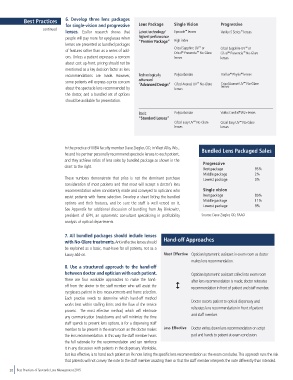
In the practice of MBA faculty member Dave Ziegler, OD, in West Allis, Wis., Bundled Lens Packaged Sales
he and his partner personally recommend spectacle lenses to each patient, and Lens
and they achieve ratios of lens sales by bundled package as shown in the Progressive
chart to the right. Recommen-
Best package 95%
Middle package 2%
These numbers demonstrate that price is not the dominant purchase Lowest package 3% dations
consideration of most patients and that most will accept a doctor’s lens
recommendation when consistently made and conveyed to opticians who Single vision
assist patients with frame selection. Develop a sheet listing the bundled Best package 80%
options and their features, and be sure the staff is well versed on it. Middle package 11%
9%
Lowest package
See Appendix for additional discussion of bundling from Jay Binkowitz,
president of GPN, an optometric consultant specializing in profitability Source: Dave Ziegler, OD, FAAO
analysis of optical departments.
7. All bundled packages should include lenses
with No-Glare treatments. Anti-reflective lenses should Hand-off Approaches
be explained as a basic, must-have for all patients, not as a
luxury add-on. Most Effective Optician/optometric assistant in exam room as doctor
makes lens recommendation.
8. Use a structured approach to the hand-off
between doctor and optician with each patient. Optician/optometric assistant called into exam room
There are four workable approaches to make the hand- after lens recommendation is made; doctor reiterates
off from the doctor to the staff member who will assist the recommendation in front of patient and staff member.
eyeglasses patient in lens measurements and frame selection.
Each practice needs to determine which hand-off method
works best within staffing limits and the flow of the service Doctor escorts patient to optical dispensary and
process. The most effective method, which will eliminate reiterates lens recommendation in front of patient
any communication breakdowns and will minimize the time and staff member.
staff spends to present lens options, is for a dispensing staff
member to be present in the exam room as the doctor makes Less Effective Doctor writes down lens recommendation on script
the lens recommendation. In this way the staff member hears pad and hands to patient at exam conclusion.
the full rationale for the recommendation and can reinforce
it in any discussion with patients in the dispensary. Workable,
but less effective, is to hand each patient an Rx note listing the specific lens recommendation as the exam concludes. This approach runs the risk
that patients will not convey the note to the staff member assisting them or that the staff member interprets the note differently than intended.
20 Best Practices of Spectacle Lens Management 2015

