


Page 16 - 2015 Best Practices of Spectacle Lens Management
P. 16
Product         Implications of consumer behavior and attitudes for eyewear selection

                 Mix       •  ECP decisions should be the major determinant of which lenses are dispensed in a practice. Few consumers are equipped
                             to sort through the options and make good decisions about their lenses. ECPs should determine which few of the hundreds
                 continued   of lens types and brands available offer the best performance and produce the highest satisfaction among patients, then guide patients to
                             these products. If a practice is overwhelmed by the complexity of spectacle lens offerings, it is certain that patients will be as well.
                           •  In most practices, ECP lens selections should be weighted to lenses that satisfy the discriminating requirements of affluent,
                             educated patients. These patients account for a high share of eyewear purchases in most practices. Their needs and desires are shared
                             by people with more modest income. Orienting the product mix to the affluent conveys to all patients that the practice offers the latest
                             technology and appeals to sophisticated consumers.
                           •  Spectacle lenses should be presented as complete (or “bundled”) packages of features, not as a series of choices
                             of material, design and other treatments. This approach simplifies the purchase process and assures that a higher proportion of patients
                             have the benefit of the latest technology. In presenting spectacle lens options to patients, the precept “less is more” definitely applies.
                             Overwhelming patients with technical detail and add-ons creates indecision.
                           •  Spectacle lens packages should be presented to patients starting with the highest performance option with the assumption
                             that patients want the best.


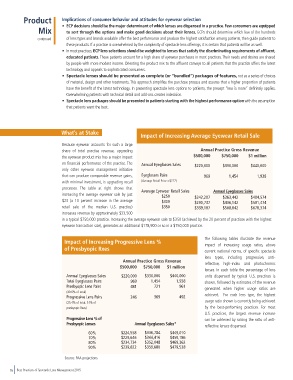
                           What’s at Stake
                                                            Impact of Increasing Average Eyewear Retail Sale
                           Because eyewear accounts for such a large
                           share of total practice revenue, upgrading                Annual Practice Gross Revenue
                           the eyewear product mix has a major impact             $500,000          $750,000         $1 million
                           on financial performance of the practice. The   Annual Eyeglasses Sales  $220,000  $330,000  $440,000
                           only other eyewear management initiative
                           that can produce comparable revenue gains,   Eyeglasses Pairs  969    1,454      1,938
                           with minimal investment, is upgrading recall   (Average Retail Price =$227)
                           processes.  The  table  at  right  shows  that   Average Eyewear Retail Sales  Annual Eyeglasses Sales
                           increasing the average eyewear sale by just   $250     $242,287    $363,442    $484,574
                           $23 (a 10 percent increase in the average   $300       $290,737    $436,142    $581,474
                           retail  sale  of  the  median  U.S.  practice)   $350  $339,187    $508,842    $678,374
                           increases revenue by approximately $33,500
                           in a typical $750,000 practice. Increasing the average eyewear sale to $350 (achieved by the 20 percent of practices with the highest
                           eyewear transaction size), generates an additional $178,900 or so in a $750,000 practice.


                                                                                       The following tables illustrate the revenue
                            Impact of Increasing Progressive Lens %                    impact of increasing usage ratios, above
                            of Presbyopic Rxes                                         current national norms, of specific spectacle
                                                                                       lens types, including progressive, anti-
                                                    Annual Practice Gross Revenue      reflective, high-index and photochromic
                                                   $500,000      $750,000      $1 million
                                                                                       lenses. In each table the percentage of lens
                             Annual Eyeglasses Sales  $220,000  $330,000  $440,000     units dispensed by typical U.S. practices is
                             Total Eyeglasses Pairs     969     1,454      1,938       shown, followed by estimates of the revenue
                             Presbyopic Lens Pairs      481      721        961        generated when higher usage ratios are
                             (49.6% of total)                                          achieved.  For each lens type, the highest
                             Progressive Lens Pairs     246      369        492
                             (25.4% of total, 51% of                                   usage ratio shown is currently being achieved
                             presbyopic Rxes)                                          by the best-performing practices. For most
                                                                                       U.S. practices, the largest revenue increase
                             Progressive Lens % of                                     can be achieved by raising the ratio of anti-
                             Presbyopic Lenses           Annual Eyeglasses Sales*      reflective lenses dispensed.
                                      60%           $224,558  $336,784  $449,010
                                      70%           $229,646  $344,416  $459,186
                                      80%           $234,734  $352,048  $469,362
                                      90%           $239,822  $359,680  $479,538

                            Source: PAA projections

     16  Best Practices of Spectacle Lens Management 2015

