


Page 14 - 2015 Best Practices of Spectacle Lens Management
P. 14
Product           Not only are eyeglasses wearers uninformed about spectacle lens options, they also have only a sketchy idea about what a pair of spectacle lenses should
                            cost. Eyeglasses are infrequently purchased and incorporate so many variables that it’s difficult to comparison shop. Patients may see chain optical ads that
                Mix         feature two pairs of glasses for $99 (including frames), reducing perceived value of eyeglasses. Or they may assume that their vision insurance allowance

                continued   should cover the complete cost of a pair of glasses, including the latest technology. It’s all very difficult for patients to sort out.
                            That’s not to say that patients care mainly about limiting their eyewear outlay and place little value on superior performance of their eyeglasses.
                            The truth is that American consumers are becoming increasingly discriminating and demanding about most products they buy, including eyewear.
                            This is a result of increasing education and income and broader exposure to high-performance products from around the world.

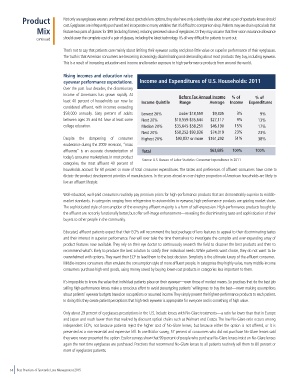
                            Rising incomes and education raise
                            eyewear performance expectations.  Income and Expenditures of U.S. Households: 2011
                            Over the past four decades, the discretionary
                            income of Americans has grown rapidly. At       Before Tax Annual Income  % of    % of
                            least 40 percent of households can now be   Income Quintile  Range                 Average     Income     Expenditures
                            considered affluent, with incomes exceeding
                            $58,000 annually. Sixty percent of adults   Lowest 20%  Under $18,559  $9,805  3%  9%
                            between ages 25 and 64 have at least some   Next 20%  $18,559-$35,644  $27,117  9%  13%
                            college education.              Median 20%    $35,645-$58,251  $46,190  15%      17%
                                                            Next 20%      $58,252-$93,836  $74,019  23%      23%
                            Despite the dampening of consumer   Highest 20%  $93,837 or more  $161,292  51%  38%
                            exuberance during the 2009 recession, “mass
                            affluence” is an accurate characterization of   Total         $63,685         100%   100%
                            today’s consumer marketplace. In most product   Source: U.S. Bureau of Labor Statistics: Consumer Expenditures in 2011
                            categories, the most affluent 40 percent of
                            households account for 60 percent or more of total consumer expenditures. The tastes and preferences of affluent consumers have come to
                            dictate the product development priorities of manufacturers. In the years ahead an even higher proportion of American households are likely to
                            live an affluent lifestyle.

                            Well-educated, well-paid consumers routinely pay premium prices for high-performance products that are demonstrably superior to middle-
                            market standards. In categories ranging from refrigerators to automobiles to eyewear, high-performance products are gaining market share.
                            The sophisticated style of consumption of the emerging affluent majority is a form of self-expression. High-performance products bought by
                            the affluent are not only functionally better, but offer self-image enhancement—revealing the discriminating taste and sophistication of their
                            buyers to other people in the community.


                            Educated, affluent patients expect that their ECPs will recommend the best package of lens features to appeal to their discriminating tastes
                            and their interest in superior performance. Few will ever take the time themselves to investigate the complex and ever-expanding array of
                            product features now available. They rely on their eye doctor to continuously research the field to discover the best products and then to
                            recommend what’s likely to produce the best solution to satisfy their individual needs. While patients want choice, they do not want to be
                            overwhelmed with options. They want their ECP to lead them to the best decision. Simplicity is the ultimate luxury of the affluent consumer.
                            Middle-income consumers often emulate the consumption style of more affluent people. In categories they highly value, many middle-income
                            consumers purchase high-end goods, using money saved by buying lower-cost products in categories less important to them.

                            It’s impossible to know the value that individual patients place on their eyewear—even those of modest means. So practices that do the best job
                            selling high-performance lenses make a conscious effort to avoid stereotyping patients’ willingness to buy the best—never making assumptions
                            about patients’ eyewear budgets based on occupations or assumed income. They simply present the highest-performance products to each patient.
                            In doing this they create patient perceptions that high-tech eyewear is appropriate for everyone and is something of high value.

                            Only about 29 percent of eyeglasses prescriptions in the U.S. include lenses with No-Glare treatments—a ratio far lower than that in Europe
                            and Japan and much lower than that realized by discount optical chains such as Walmart and Costco. The low No-Glare ratio occurs among
                            independent ECPs, not because patients reject the higher cost of No-Glare lenses, but because either the option is not offered, or it is
                            presented as a non-essential and expensive frill. In one Essilor survey, 57 percent of consumers who did not purchase No-Glare lenses said
                            they were never presented the option. Essilor surveys show that 99 percent of people who purchase No-Glare lenses insist on No-Glare lenses
                            again the next time eyeglasses are purchased. Practices that recommend No-Glare lenses to all patients routinely sell them to 80 percent or
                            more of eyeglasses patients.


     14  Best Practices of Spectacle Lens Management 2015

