


Page 13 - 2015 Best Practices of Spectacle Lens Management
P. 13
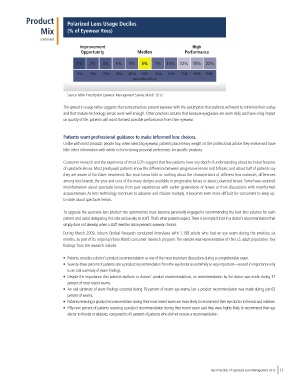
Product          Polarized Lens Usage Deciles

                  Mix        (% of Eyewear Rxes)

                  continued
                                  Improvement                                    High
                                   Opportunity            Median              Performance

                                 1%   2%    3%   5%    5%   5%    7%   10%  12%   15%  22%

                                   5th       15th       25th      35th      45th      50th       55th      65th      75th      85th      95th
                                                         percentile ranking


                             Source: MBA Prescription Eyewear Management Survey, March 2012

                            The spread in usage ratios suggests that some practices present eyewear with the assumption that patients will want to minimize their outlay
                            and that mature-technology lenses work well enough. Other practices assume that because eyeglasses are worn daily and have a big impact
                            on quality of life, patients will want the best possible performance from their eyewear.


                            Patients want professional guidance to make informed lens choices.
                            Unlike with most products people buy, when selecting eyewear, patients place heavy weight on the professional advice they receive and have
                            little other information with which to form strong personal preferences for specific products.


                            Consumer research and the experience of most ECPs suggest that few patients have any depth of understanding about technical features
                            of spectacle lenses. Most presbyopic patients know the difference between progressive lenses and bifocals, and about half of patients say
                            they are aware of No-Glare treatments. But most know little or nothing about the characteristics of different lens materials, differences
                            among lens brands, the pros and cons of the many designs available in progressive lenses or about polarized lenses. Some have acquired
                            misinformation about spectacle lenses from past experiences with earlier generations of lenses or from discussions with misinformed
                            acquaintances. As lens technology continues to advance and choices multiply, it becomes even more difficult for consumers to keep up-
                            to-date about spectacle lenses.


                            To upgrade the spectacle lens product mix optometrists must become personally engaged in recommending the best lens solution for each
                            patient and avoid delegating this role exclusively to staff.  That’s what patients expect. There is an implicit trust in a doctor’s recommendation that
                            simply does not develop when a staff member alone presents eyewear choices.
                           During March 2009, Jobson Optical Research conducted interviews with 1,198 adults who had an eye exam during the previous six
                           months, as part of its ongoing Vision Watch consumer research program. The sample was representative of the U.S. adult population. Key
                           findings from the research include:

                           •  Patients consider a doctor’s product recommendation as one of the most important discussions during a comprehensive exam.
                           •  Seventy-three percent of patients rate a product recommendation from the eye doctor as extremely or very important—second in importance only
                             to an oral summary of exam findings.
                           •  Despite the importance that patients attribute to doctors’ product recommendations, no recommendation by the doctor was made during 37
                             percent of most recent exams.
                           •  An oral summary of exam findings occurred during 79 percent of recent eye exams, but a product recommendation was made during just 63
                             percent of exams.
                           •  Patients receiving a product recommendation during their most recent exam are more likely to recommend their eye doctor to friends and relatives.
                           •  Fifty-nine percent of patients receiving a product recommendation during their recent exam said they were highly likely to recommend their eye
                             doctor to friends or relatives, compared to 43 percent of patients who did not receive a recommendation.


                                                                                         Best Practices of Spectacle Lens Management 2015  13

