


Page 28 - 2015 Best Practices of Spectacle Lens Management
P. 28
Retail       Effective management of eyewear retail pricing can have a major impact on practice profitability. If prices are set too low, profit margins suffer, and   Retail

            Pricing        money is left on the table. If prices are too high, patients are more likely to search for lower prices at alternative providers, and the capture rate of   Pricing
                           patients’ lens purchases declines.

                           A consensus among consultants who have analyzed the retail pricing of their independent OD clients is that there is a tendency to under-price eyewear. This
                           reflects an overblown OD fear of losing business to discount optical chains. Because ODs do not know the price that will scare away patients, many set prices
                           lower than necessary. Consultants note that it’s impossible for a small business with a high service model to match Walmart’s prices and still make money.
                           There is no evidence that independents cannot retain a high share of their patients’ eyewear purchases, while pricing lenses at a premium to discount optical
                           chains. A more aggressive pricing strategy will work in most optometric practices.

                           In every practice there is a small segment of patients whose primary consideration when selecting eyewear is price. These patients may be quite vocal in
                           expressing their desire for a low price. But it makes no sense for a practice to set prices low and accept poor margins to satisfy the desires of a vocal minority.
                           For most patients of independent ECPs, price is not the most important consideration as they buy eyewear. Most patients expect to pay more for the higher
                           level of care they receive at an independent eye doctor and expect to pay more for their eyeglasses as well. They are willing to pay more both to maintain
                           the relationship with the doctor and for the convenience of having an exam and buying vision care devices at the same time and place.


                           Management & Business  Academy™ (MBA)
                           faculty member Neil Gailmard, OD, reminds ODs   Impact of Pricing on Eyewear Purchase
                           that unlike most things people buy in retail stores,   (% of patients saying statement describes “completely/very well”)
                           a pair of eyeglasses designed for a specific patient
                           incorporates a lot of professional expertise and advice          Eyewear Buyers of:
                           that should command reasonable compensation.             Optical Chain   Independent ECP
                                                             I always shop around to get the
                           A benefit of  setting  retail prices to  yield an   best prices.  46%        28%
                           acceptable  margin is that it can empower
                           independent ODs to take action to assure 100   When it comes to buying
                           percent patient satisfaction with eyewear. When   glasses, I think it is worth paying
                           profits are adequate, there’s less quibbling when   a little more to get the best.  35%  49%
                           patients complain about their new glasses and
                           request a change.                 When it comes to my vision, the
                                                             amount of  money I spend is not
                                                             a concern.                   21%           30%
                                                            Source: Essilor AR Coating Pricing Survey-Independent Versus Retail Chain, 2007

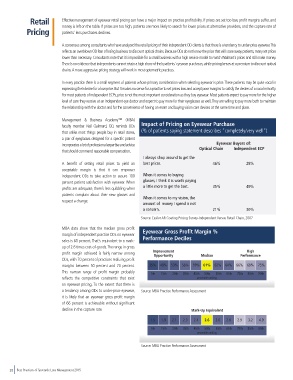
                           MBA data show that the median gross profit
                           margin of independent practice ODs on eyewear   Eyewear Gross Profit Margin %
                           sales is 61 percent. That’s equivalent to a mark-  Performance Deciles
                           up of 2.6 times cost-of-goods. The range in gross
                                                                                                        High
                           profit margin achieved is fairly narrow among   Improvement   Median      Performance
                                                                 Opportunity
                           ODs, with 70 percent of practices realizing profit
                           margins between 50 percent and 70 percent.   35%  48%  53%  56%  59% 61%  62%  64%  66%  69%  75%
                           This  narrow  range  of  profit  margin  probably     5th       15th       25th      35th      45th      50th       55th      65th      75th      85th      95th
                           reflects the competitive constraints that exist         percentile ranking
                           on eyewear pricing. To the extent that there is
                           a tendency among ODs to under-price eyewear,   Source: MBA Practice Performance Assessment
                           it is likely that an eyewear gross profit margin
                           of 66 percent is achievable without significant
                           decline in the capture rate.                          Mark-Up Equivalent

                                                                1.5  1.9  2.1  2.3  2.4  2.6  2.6  2.8  2.9  3.2  4.9
                                                                 5th       15th       25th      35th      45th      50th       55th      65th      75th      85th      95th
                                                                                   percentile ranking


                                                            Source: MBA Practice Performance Assessment


     28  Best Practices of Spectacle Lens Management 2015

