


Page 33 - 2015 Best Practices of Spectacle Lens Management
P. 33
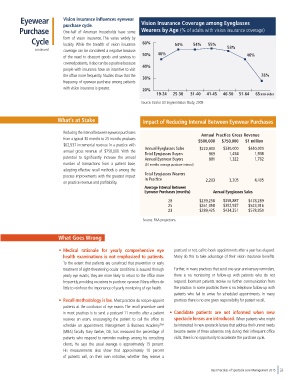
Eyewear          Vision insurance influences eyewear   Vision Insurance Coverage among Eyeglasses
                           purchase cycle.
         Purchase          One-half of  American households have some   Wearers by Age (% of adults with vision insurance coverage)

 Total        Cycle        form of vision insurance. This varies widely by   60%  54%  54%  55%
                           locality. While the breadth of vision insurance
                continued  coverage can be considered a negative because                        53%
                           of the need to discount goods and services to   50%  46%                     46%
                           covered patients, it also can be a positive because
                           people with insurance have an incentive to visit   40%
                           the office more frequently. Studies show that the   30%                            28%
                           frequency of eyewear purchase among patients
                           with vision insurance is greater.  20%
                                                                  19-24  25-30   31-40  41-45  46-50  51-64  65 and older
                                                            Source: Essilor US Segmentation Study, 2008


                         What’s at Stake
 12 months       Longer than 12 months                       Impact of Reducing Interval Between Eyewear Purchases
                           Reducing the interval between eyewear purchases           Annual Practice Gross Revenue
                           from a typical 30 months to 25 months produces           $500,000      $750,000      $1 million
                           $62,937 incremental revenue in a practice with
                           annual gross revenue of $750,000.  With the   Annual Eyeglasses Sales  $220,000  $330,000  $440,000
                                                                                                 1,454
                                                                                        969
                                                              Total Eyeglasses Buyers
                                                                                                           1,938
                           potential to significantly increase the annual   Annual Eyewear Buyers  881  1,322  1,762
                           number of transactions from a patient base,   (30 months average purchase interval)
                           adopting effective recall methods is among the
                           process improvements with the greatest impact   Total Eyeglasses Wearers
                                                              In Practice
                           on practice revenue and profitability.                      2,203     3,305     4,405
                                                             Average Interval Between
                                                             Eyewear Purchases (months)   Annual Eyeglasses Sales
                                                                       28           $239,258  $358,887   $478,289
                                                                       25           $261,958  $392,937   $523,916
                                                                       23           $289,425  $434,251   $578,850

                                                             Source: PAA projections


                         What Goes Wrong

                          •  Medical rationale for yearly comprehensive eye   postcard or not, call to book appointments after a year has elapsed.
                           health examinations is not emphasized to patients.     Many do this to take advantage of their vision insurance benefits.
                           To the extent that patients are convinced that prevention or early
                           treatment of sight-threatening ocular conditions is assured through   Further, in many practices that send one-year anniversary reminders,
                           yearly eye exams, they are more likely to return to the office more   there is no monitoring or follow-up with patients who do not
                           frequently, providing occasions to purchase eyewear. Many offices do   respond. Dormant patients receive no further communication from
                           little to reinforce the importance of yearly monitoring of eye health.  the practice. In some practices there is no telephone follow-up with
                                                                          patients who fail to arrive for scheduled appointments. In many
                          •  Recall methodology is lax. Most practices do not pre-appoint   practices there is no one given responsibility for patient recall.
                           patients at the conclusion of eye exams. The recall procedure used
                           in most practices is to send a postcard 11 months after a patient  •  Candidate patients are not informed when new
                           receives an exam, encouraging the patient to call the office to   spectacle lenses are introduced. When patients who might
                           schedule an appointment. Management & Business  Academy™   be interested in new spectacle lenses that address their unmet needs
                           (MBA) faculty Gary Gerber, OD, has measured the percentage of   become aware of these advances only during their infrequent office
                           patients who respond to reminder mailings among his consulting   visits, there is no opportunity to accelerate the purchase cycle.
                           clients. He says the usual average is approximately 15 percent.
                           His measurements  also show that  approximately 10 percent
                           of patients will, on their own initiative, whether they receive a


                                                                                         Best Practices of Spectacle Lens Management 2015  33

