


Page 37 - 2015 Best Practices of Spectacle Lens Management
P. 37
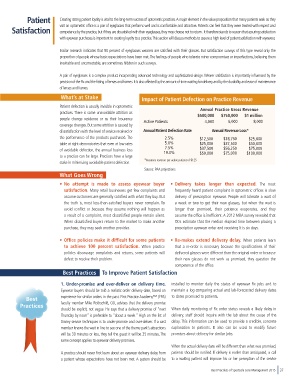
Patient       Creating strong patient loyalty is vital to the long-term success of optometric practices. A major element in the value proposition that many patients seek as they

      Satisfaction        visit an optometric office is a pair of eyeglasses that performs well and is comfortable and attractive. Patients can feel that they were treated with respect and
                          competence by the practice, but if they are dissatisfied with their eyeglasses, they may choose not to return.  It therefore stands to reason that assuring satisfaction
                          with eyewear purchases is important to creating loyalty to a practice. This section will discuss methods to assure a high level of patient satisfaction with eyewear.

                          Essilor research indicates that 90 percent of eyeglasses wearers are satisfied with their glasses. But satisfaction surveys of this type reveal only the
                          proportion of people whose basic expectations have been met. The feelings of people who tolerate minor compromises or imperfections, believing them
                          inevitable and uncorrectable, are sometimes hidden in such surveys.

                          A pair of eyeglasses is a complex product incorporating advanced technology and sophisticated design. Wearer satisfaction is importantly influenced by the
                          precision of the Rx and the fitting of lenses and frames. It is also affected by the amount of time waiting for delivery and by the durability and ease of maintenance
                          of lenses and frames.
                          What’s at Stake                   Impact of Patient Defection on Practice Revenue

                          Patient defection is usually invisible in optometric
                                                                                     Annual Practice Gross Revenue
                          practices. There is some unavoidable attrition as         $500,000      $750,000      $1 million
                          people change residence or as their insurance   Active Patients  4,000  6,000    8,000
                          coverage changes. But some attrition is caused by
                          dissatisfaction with the level of service received or   Annual Patient Defection Rate  Annual Revenue Loss*
                          the performance of the products purchased. The   2.5%     $12,500   $18,750    $25,000
                          table at right demonstrates that even at low rates   5.0%  $25,000  $37,500    $50,000
                                                                      7.5%
                          of avoidable defection, the annual business loss   10.0%  $37,500   $56,250    $75,000
                          to a practice can be large. Practices have a large        $50,000   $75,000   $100,000
                                                             *Assumes revenue per active patient of $125
                          stake in minimizing avoidable patient defection.
                                                             Source: PAA projections
                          What Goes Wrong
                          • No attempt is made to assess eyewear buyer  • Delivery takes longer than expected.  The most
                            satisfaction. Many retail businesses get few complaints and   frequently heard patient complaint in optometric offices is slow
                            assume customers are generally satisfied with what they buy. But   delivery of prescription eyewear. People will tolerate a wait of
                            the truth is, most less-than-satisfied buyers never complain. To   a week or two to get their new glasses, but when the wait is
                            avoid conflict or because they assume nothing will happen as   longer than promised, their patience evaporates, and they
                            a result of a complaint, most dissatisfied people remain silent.   assume the office is inefficient. A 2012 MBA survey revealed that
                            When dissatisfied buyers return to the market to make another   ODs estimate that the median elapsed time between placing a
                            purchase, they may seek another provider.     prescription eyewear order and receiving it is six days.

                          • Office policies make it difficult for some patients  • Re-makes extend delivery delay. When patients learn
                            to achieve 100 percent satisfaction.  When  practice   that a re-order is necessary because the specifications of their
                            policies discourage complaints and returns, some patients will   delivered glasses were different than the original order or because
                            defect to resolve their problem.              their new glasses do not work as promised, they question the
                                                                          competence of the office.
                           Best Practices   To Improve Patient Satisfaction

                          1. Under-promise and over-deliver on delivery time.  installed to monitor daily the status of eyewear Rx jobs and to
                          Eyewear buyers should be told a realistic order delivery date, based on   maintain a log comparing actual and lab-forecasted delivery dates
            Best          experience for similar orders in the past. First Practice Academy™ (FPA)   to dates promised to patients.
         Practices        faculty member Mike Rothschild, OD, advises that the delivery promise
                          should be explicit, not vague. He says that a delivery promise of “next   When daily monitoring of Rx order status reveals a likely delay in
                          Thursday by noon” is preferable to “about a week.” High on the list of   delivery, staff should inquire with the lab about the cause of the
                          Disney service techniques is to under-promise and over-deliver. If a cast   delay. This information can be used to provide a credible, concrete
                          member knows the wait in line to see one of the theme park’s attractions   explanation to patients. It also can be used to modify future
                          will be 30 minutes or less, they tell the guest it will be 35 minutes. The   promises about delivery for similar jobs.
                          same concept applies to eyewear delivery promises.
                                                                         When the actual delivery date will be different than what was promised,
                          A practice should never first learn about an eyewear delivery delay from   patients should be notified. If delivery is earlier than anticipated, a call
                          a patient whose expectations have not been met. A system should be   to a waiting patient will improve his or her perception of the service

                                                                                         Best Practices of Spectacle Lens Management 2015  37

