


Page 29 - 2015 Best Practices of Spectacle Lens Management
P. 29
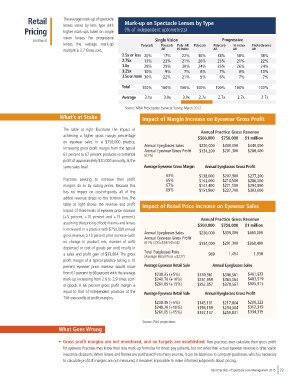
Retail        The average mark-up of spectacle   Mark-up on Spectacle Lenses by Type

           Pricing         lenses varies by lens type with   (% of independent optometrists)
                           higher mark-ups taken on single
                           vision lenses. For progressive
               continued                                          Single Vision               Progressive
                           lenses the average mark-up       Polycarb         Polycarb     Poly  AR      Polycarb         Polycarb         Hi-index        Photochromic
                           multiple is 2.7 times cost.                AR   Hi-Index       AR      AR        AR
                                                    2.5x or less 20%  17%    22%    36%     38%     38%       38%
                                                    2.75x    13%     23%     21%    26%     23%     21%       22%
                                                    3.0x     28%     29%     30%    24%     25%     26%       24%
                                                    3.25x    10%      9%      7%     8%      7%      8%       10%
                                                    3.5x or more 30%  22%    21%     5%      6%      7%        7%

                                                    Total   100%    100%    100%   100%    100%    100%      100%

                                                    Average   3.1x   3.0x    3.0x   2.7x    2.7x    2.7x      2.7x

                                                     Source: MBA Prescription Eyewear Survey, March 2012
                          What’s at Stake                   Impact of Margin Increase on Eyewear Gross Profit

                           The table at right illustrates the impact of              Annual Practice Gross Revenue
                           achieving a higher gross margin percentage               $500,000      $750,000      $1 million
                           on eyewear sales. In a $750,000 practice,
                           increasing gross profit margin from the typical   Annual Eyeglasses Sales  $220,000  $330,000  $440,000
                                                                                              $201,300
                                                                                                         $268,400
                                                                                    $134,200
                                                             Annual Eyewear Gross Profit
                           61 percent to 67 percent produces incremental   (61%)
                           profit of approximately $20,000 annually, at the
                           same sales level.                 Average Eyewear Gross Margin  Annual Eyeglasses Gross Profit
                                                                      63%           $138,600  $207,900   $277,200
                           Practices seeking to increase their profit   65%         $143,000  $214,500   $286,000
                           margins do so by raising prices. Because this   67%      $147,400  $221,100   $294,800
                           has no impact on cost-of-goods, all of the   69%         $151,800  $227,700   $303,600
                           added revenue drops to the bottom line. The
                           table at right shows the revenue and profit   Impact of Retail Price Increase on Eyewear Sales
                           impact of three levels of eyewear price increase
 Source: Essilor AR Coating Pricing Survey-Independent Versus Retail Chain, 2007  (+5 percent, +10 percent and +15 percent),   Annual Practice Gross Revenue
                           assuming that pricing of both frames and lenses          $500,000      $750,000      $1 million
                           is increased. In a practice with $750,000 annual
                           gross revenue, a 10 percent price increase (with   Annual Eyeglasses Sales  $220,000  $330,000  $440,000
                                                             Annual Eyewear Gross Profit
                           no change in product mix, number of units   (61% COG=$88.54/unit)  $134,000  $201,300  $268,400
                           dispensed or cost-of goods per unit) results in
                           a sales and profit gain of $33,064. The gross   Total Eyeglasses Pairs  969  1,454  1,938
                                                             (Average Retail Price =$227)
                           profit margin of a typical practice taking a 10
                           percent  eyewear  price  increase  would  move   Average Eyewear Retail Sale  Annual Eyeglasses Sales
                           from 61 percent to 66 percent with the average   $238.35 (+5%)  $130,961  $346,561  $461,922
                           mark-up increasing from 2.6 to 2.9 times cost-  $249.70 (+10%)  $241,959  $363,064  $483,919
                           of-goods. A 66 percent gross profit margin is   $261.05 (+15%)  $252,957  $379,567  $505,915
                           equal to that of independent practices at the   Average Eyewear Retail Sale  Annual Eyeglasses Gross Profit
                           75th percentile of profit margins.
                                                                  $238.35 (+5%)    $145,161   $217,864   $290,322
                                                                  $249.70 (+10%)   $156,159   $234,364   $312,319
                                                                  $261.05 (+15%)   $167,157   $250,831   $334,315

                                                               Source: PAA projections
                          What Goes Wrong

                          • Gross profit margins are not monitored, and no targets are established. Few practices ever calculate their gross profit
                           for eyewear. Practices may know their lens mark-up formulas for direct-pay patients, but not what their actual eyewear revenue is after vision
                           insurance discounts. When lenses and frames are purchased from many sources, it can be laborious to compute purchases, which is necessary
                           to calculate profit. If margins are not measured, it becomes impossible to make informed judgments about pricing.

                                                                                         Best Practices of Spectacle Lens Management 2015  29

