


Page 31 - 2015 Best Practices of Spectacle Lens Management
P. 31
Eyewear         It’s been said that there are three principal ways   Frequency of Purchase of Prescription Eyewear

          Purchase         for retail businesses to increase revenue: attract   (% of eyewear buyers)
                           more customers, sell more to each customer
                Cycle      or get customers to buy more frequently. This   Less often than every three years  7%
                           section addresses the last of these revenue
                           growth strategies.               About every three years                        9%
                                                            About every two years                         38%
                                                            About every 18 months                         15%
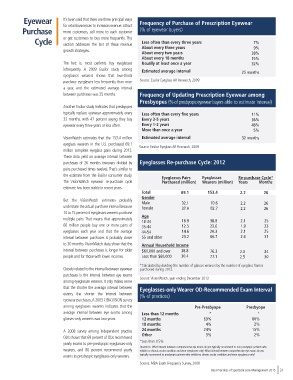
                           The fact is, most patients buy eyeglasses   Usually at least once a year       32%
                           infrequently.  A 2009 Essilor study among   Estimated average interval
                           eyeglasses  wearers shows that two-thirds                                  25 months
                           purchase eyeglasses less frequently than once   Source: Essilor Eyeglass AR Research, 2009
                           a year, and the estimated average interval
                           between purchases was 25 months.   Frequency of Updating Prescription Eyewear among
                                                           Presbyopes (% of presbyopic eyewear buyers able to estimate interval)
                           Another Essilor study indicates that presbyopes
                           typically replace eyewear approximately every   Less often than every five years  11%
                           32 months, with 47 percent saying they buy   Every 3-5 years                   36%
                           eyewear every three years or less often.  Every 1-2 years                      48%
                                                            More than once a year                          5%
                           VisionWatch estimates that the 153.4 million   Estimated average interval  32 months
                           eyeglass wearers in the U.S. purchased 69.1   Source: Essilor Eyeglass AR Research, 2009
                           million complete eyeglass pairs during 2012.
                           These data yield an average interval between
                           purchases of 26 months (wearers divided by   Eyeglasses Re-purchase Cycle: 2012
                           pairs purchased times twelve). That’s similar to
                           the estimate from the Essilor consumer study.
 Example of Retail Pricing Calculation  The  VisionWatch eyewear re-purchase cycle   Eyeglasses Pairs   Eyeglasses   Re-purchase Cycle*
                                                                                                     Years
                                                                                                               Months
                                                                     Purchased (million)
                                                                                      Wearers (million)
 Applying Margin Goal to Wholesale Cost  estimate has been stable in recent years.
                                                            Total            69.1       153.4        2.2       26
                                                            Gender
                           But the  VisionWatch estimates probably   Male    32.1        70.6         2.2      26
                           understate the actual purchase interval because   Female  37.0  82.7       2.2      26
                           10 to 15 percent of eyeglasses wearers purchase
                           multiple pairs. That means that approximately   Age  18.9     38.8         2.1      25
                                                            18-34
                           60 million people buy one or more pairs of   35-44  12.5      23.6         1.9      23
                           eyeglasses  each  year  and  that  the  average   44-54  14.6  20.3        2.1      25
                           interval between purchases is probably closer   55 and older  23.2  60.7   2.6      31
                           to 30 months. VisionWatch data show that the   Annual Household Income
                           interval between purchases is longer for older   $60,000 and over  38.8  76.3  2.0  24
                           people and for those with lower incomes.  Less than $60,000  30.4  77.1   2.5       30

                                                           *Calculated by dividing the number of glasses wearers by the number of eyeglass frames
                           Closely related to the interval between eyewear   purchased during 2012.
                           purchases is the interval between eye exams
                           among eyeglasses wearers. It only makes sense   Source: VisionWatch, year ending December 2012
                           that the shorter the average interval between   Eyeglasses-only Wearer OD-Recommended Exam Interval
                           exams, the shorter the interval between   (% of practices)
                           eyewear purchases. A 2005 CIBA VISION survey
                           among eyeglasses wearers indicates that the            Pre-Presbyope         Presbyope
                           average interval between eye exams among   Less than 12 months  *                 *
                           glasses-only wearers was two years.  12 months             69%                 80%
                                                            18 months                  4%                  2%
                           A 2008 survey among independent practice   24 months       24%                 15%
                           ODs shows that 69 percent of ODs recommend   Other          3%                  2%
                                                            *Less than 0.5%
                           yearly exams to pre-presbyopic eyeglasses-only
                                                            Questions:  What interval between comprehensive eye exams do you typically recommend to non-presbyopic patients who
                           wearers, and 80 percent recommend yearly   exhibit no chronic ocular condition and wear eyeglasses only? What interval between comprehensive eye exams do you
                           exams to presbyopic eyeglasses-only wearers.   typically recommend to presbyopic patients who exhibit no chronic ocular condition and wear eyeglasses only?
                                                            Source: MBA Exam Frequency Survey, 2008
                                                                                         Best Practices of Spectacle Lens Management 2015  31

