


Page 102 - [Uma_Sekaran]_Research_methods_for_business__a_sk(BookZZ.org)
P. 102
86  THE RESEARCH PROCESS


                         1
                    OBSERVATION
                     Broad area
                     of research
                       interest
                      identified
                                             4
                                        THEORETICAL
                                3                          5              6               7
                                         FRAMEWORK
                             PROBLEM                   GENERATION
                            DEFINITION                     OF         SCIENTIFIC   DATA COLLECTION,
                             Research                  HYPOTHESES     RESEARCH      ANALYSIS, AND
                              problem   Variables clearly              DESIGN      INTERPRETATION
                             delineated  identified and
                                           labeled
                         2
                                                                                          8
                    PRELIMINARY
                  DATA GATHERING                                                     DEDUCTION
                     Interviewing                                                     Hypotheses
                   Literature survey                                                 substantiated?
                                                                                    Research question
                                                                                      answered?


                                             No                    Yes

                                                                    9           10          11
                                                                  Report      Report     Managerial
                                                                  Writing   Presentation  Decision
                                                                                          Making


                             In the previous chapter, the focus was on learning how to narrow down and
                             clearly define the research problem. But mere definition of the problem does not
                             solve it. How, then, does one proceed further? The answer is by going through the
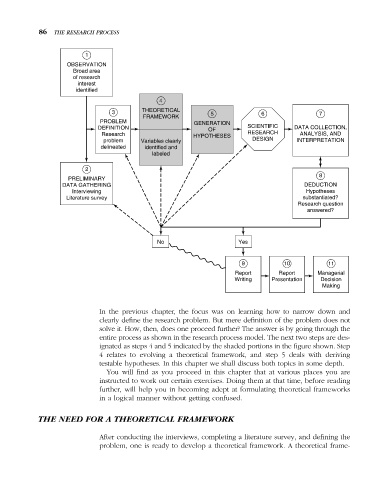
                             entire process as shown in the research process model. The next two steps are des-
                             ignated as steps 4 and 5 indicated by the shaded portions in the figure shown. Step
                             4 relates to evolving a theoretical framework, and step 5 deals with deriving
                             testable hypotheses. In this chapter we shall discuss both topics in some depth.
                               You will find as you proceed in this chapter that at various places you are
                             instructed to work out certain exercises. Doing them at that time, before reading
                             further, will help you in becoming adept at formulating theoretical frameworks
                             in a logical manner without getting confused.


            THE NEED FOR A THEORETICAL FRAMEWORK

                             After conducting the interviews, completing a literature survey, and defining the
                             problem, one is ready to develop a theoretical framework. A theoretical frame-

