


Page 175 - [Uma_Sekaran]_Research_methods_for_business__a_sk(BookZZ.org)
P. 175
TYPES OF EXPERIMENTAL DESIGNS AND INTERNAL VALIDITY  159

                             not measure the true cause-and-effect relationship. This is so because there is
                             no comparison between groups, nor any recording of the status of the depen-
                             dent variable as it was prior to the experimental treatment and how it changed
                             after the treatment. In the absence of such control, the study is of no scientific
                             value in determining cause-and-effect relationships. Hence, such a design is
                             referred to as a quasi-experimental design. The following two are quasi-exper-
                             imental designs.


                             Pretest and Posttest Experimental Group Design
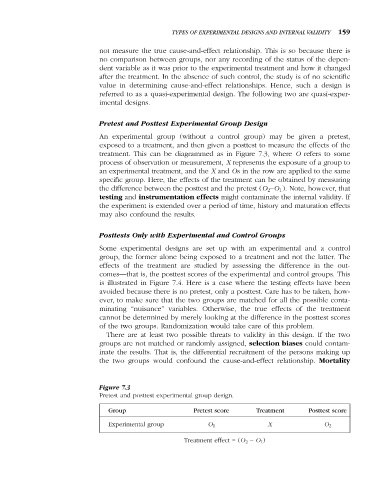
                             An experimental group (without a control group) may be given a pretest,
                             exposed to a treatment, and then given a posttest to measure the effects of the
                             treatment. This can be diagrammed as in Figure 7.3, where O refers to some
                             process of observation or measurement, X represents the exposure of a group to
                             an experimental treatment, and the X and Os in the row are applied to the same
                             specific group. Here, the effects of the treatment can be obtained by measuring
                             the difference between the posttest and the pretest (O 2 –O 1 ). Note, however, that
                             testing and instrumentation effects might contaminate the internal validity. If
                             the experiment is extended over a period of time, history and maturation effects
                             may also confound the results.

                             Posttests Only with Experimental and Control Groups
                             Some experimental designs are set up with an experimental and a control
                             group, the former alone being exposed to a treatment and not the latter. The
                             effects of the treatment are studied by assessing the difference in the out-
                             comes—that is, the posttest scores of the experimental and control groups. This
                             is illustrated in Figure 7.4. Here is a case where the testing effects have been
                             avoided because there is no pretest, only a posttest. Care has to be taken, how-
                             ever, to make sure that the two groups are matched for all the possible conta-
                             minating “nuisance” variables. Otherwise, the true effects of the treatment
                             cannot be determined by merely looking at the difference in the posttest scores
                             of the two groups. Randomization would take care of this problem.
                               There are at least two possible threats to validity in this design. If the two
                             groups are not matched or randomly assigned, selection biases could contam-
                             inate the results. That is, the differential recruitment of the persons making up
                             the two groups would confound the cause-and-effect relationship.  Mortality


                             Figure 7.3
                             Pretest and posttest experimental group design.

                               Group                   Pretest score    Treatment      Posttest score
                               Experimental group          O 1             X               O 2

                                                    Treatment effect = (O 2 – O 1 )

