


Page 177 - [Uma_Sekaran]_Research_methods_for_business__a_sk(BookZZ.org)
P. 177
TYPES OF EXPERIMENTAL DESIGNS AND INTERNAL VALIDITY  161

                            case of assessing the impact of training on skill development, or measuring the
                            impact of technology advancement on effectiveness, some of the subjects in the
                            experimental group may drop out before the end of the experiment. It is possi-
                            ble that those who drop out are in some way different from those who stay on
                            until the end and take the posttest. If so, mortality could offer a plausible rival
                            explanation for the difference between O 2 and O 1 .

                            Solomon Four-Group Design

                            To gain more confidence in internal validity in experimental designs, it is advis-
                            able to set up two experimental groups and two control groups for the experi-
                            ment. One experimental group and one control group can be given both the
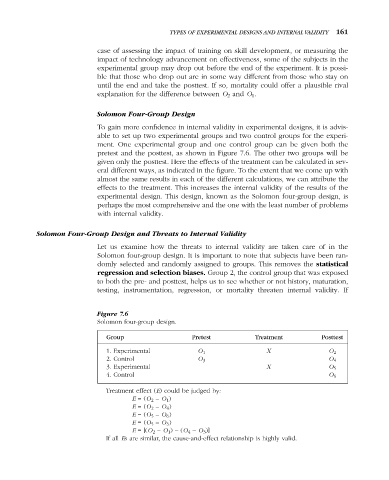
                            pretest and the posttest, as shown in Figure 7.6. The other two groups will be
                            given only the posttest. Here the effects of the treatment can be calculated in sev-
                            eral different ways, as indicated in the figure. To the extent that we come up with
                            almost the same results in each of the different calculations, we can attribute the
                            effects to the treatment. This increases the internal validity of the results of the
                            experimental design. This design, known as the Solomon four-group design, is
                            perhaps the most comprehensive and the one with the least number of problems
                            with internal validity.


           Solomon Four-Group Design and Threats to Internal Validity
                            Let us examine how the threats to internal validity are taken care of in the
                            Solomon four-group design. It is important to note that subjects have been ran-
                            domly selected and randomly assigned to groups. This removes the statistical
                            regression and selection biases. Group 2, the control group that was exposed
                            to both the pre- and posttest, helps us to see whether or not history, maturation,
                            testing, instrumentation, regression, or mortality threaten internal validity. If


                            Figure 7.6
                            Solomon four-group design.

                               Group                  Pretest           Treatment         Posttest
                               1. Experimental          O 1                X                O 2
                               2. Control               O 3                                 O 4
                               3. Experimental                             X                O 5
                               4. Control                                                   O 6

                              Treatment effect (E) could be judged by:
                                      E = (O 2 – O 1 )
                                      E = (O 2 – O 4 )
                                      E = (O 5 – O 6 )
                                      E = (O 5 – O 3 )
                                      E = [(O 2 – O 1 ) – (O 4 – O 3 )]
                              If all Es are similar, the cause-and-effect relationship is highly valid.

