


Page 189 - [Uma_Sekaran]_Research_methods_for_business__a_sk(BookZZ.org)
P. 189
FACTORIAL DESIGN  173

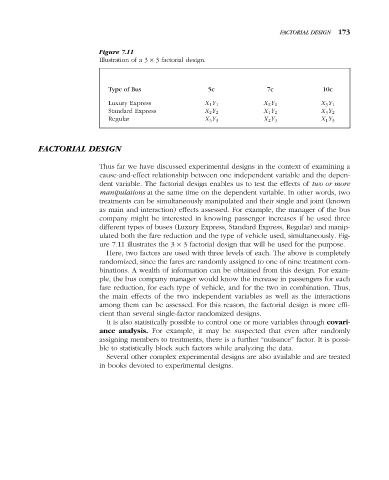
                             Figure 7.11
                             Illustration of a 3 × 3 factorial design.

                                                                 Bus Fare Reduction Rates
                               Type of Bus                 5c              7c              10c
                               Luxury Express             X 1 Y 1         X 2 Y 1         X 3 Y 1
                               Standard Express           X 2 Y 2         X 1 Y 2         X 3 Y 2
                               Regular                    X 3 Y 3         X 2 Y 3         X 1 Y 3


            FACTORIAL DESIGN

                             Thus far we have discussed experimental designs in the context of examining a
                             cause-and-effect relationship between one independent variable and the depen-
                             dent variable. The factorial design enables us to test the effects of two or more
                             manipulations at the same time on the dependent variable. In other words, two
                             treatments can be simultaneously manipulated and their single and joint (known
                             as main and interaction) effects assessed. For example, the manager of the bus
                             company might be interested in knowing passenger increases if he used three
                             different types of buses (Luxury Express, Standard Express, Regular) and manip-
                             ulated both the fare reduction and the type of vehicle used, simultaneously. Fig-
                             ure 7.11 illustrates the 3 × 3 factorial design that will be used for the purpose.
                               Here, two factors are used with three levels of each. The above is completely
                             randomized, since the fares are randomly assigned to one of nine treatment com-
                             binations. A wealth of information can be obtained from this design. For exam-
                             ple, the bus company manager would know the increase in passengers for each
                             fare reduction, for each type of vehicle, and for the two in combination. Thus,
                             the main effects of the two independent variables as well as the interactions
                             among them can be assessed. For this reason, the factorial design is more effi-
                             cient than several single-factor randomized designs.
                               It is also statistically possible to control one or more variables through covari-
                             ance analysis. For example, it may be suspected that even after randomly
                             assigning members to treatments, there is a further “nuisance” factor. It is possi-
                             ble to statistically block such factors while analyzing the data.
                               Several other complex experimental designs are also available and are treated
                             in books devoted to experimental designs.

