


Page 191 - [Uma_Sekaran]_Research_methods_for_business__a_sk(BookZZ.org)
P. 191
HOW VARIABLES ARE MEASURED  175


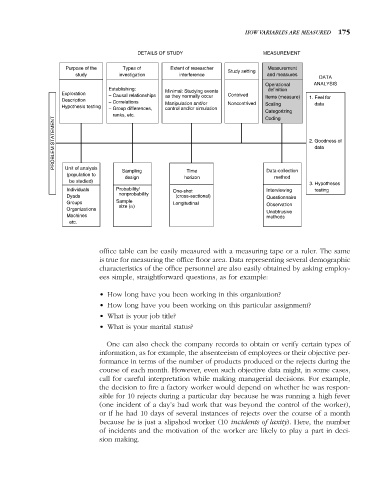
                                       DETAILS OF STUDY                   MEASUREMENT

                   Purpose of the  Types of     Extent of researcher       Measurement
                                                                Study setting
                      study       investigation    interference            and measures
                                                                                          DATA
                                                                           Operational  ANALYSIS
                               Establishing:                                 definition
                  Exploration                  Minimal: Studying events
                               – Causal relationships  as they normally occur  Contrived  Items (measure)
                  Description                                                          1. Feel for
                               – Correlations  Manipulation and/or  Noncontrived
                  Hypothesis testing                                       Scaling         data
                               – Group differences,  control and/or simulation
                                                                           Categorizing
                                  ranks, etc.                              Coding
                PROBLEM STATEMENT                                                      2. Goodness of
                                                                                           data
                   Unit of analysis
                                   Sampling          Time                  Data-collection
                    (population to
                                    design          horizon                  method
                    be studied)
                                                                                       3. Hypotheses
                    Individuals  Probability/    One-shot                  Interviewing      testing
                    Dyads          nonprobability    (cross-sectional)     Questionnaire
                    Groups       Sample          Longitudinal              Observation
                                   size (n)
                    Organizations
                                                                           Unobtrusive
                    Machines                                               methods
                      etc.
                             office table can be easily measured with a measuring tape or a ruler. The same
                             is true for measuring the office floor area. Data representing several demographic
                             characteristics of the office personnel are also easily obtained by asking employ-
                             ees simple, straightforward questions, as for example:
                             • How long have you been working in this organization?
                             • How long have you been working on this particular assignment?
                             • What is your job title?
                             • What is your marital status?

                               One can also check the company records to obtain or verify certain types of
                             information, as for example, the absenteeism of employees or their objective per-
                             formance in terms of the number of products produced or the rejects during the
                             course of each month. However, even such objective data might, in some cases,
                             call for careful interpretation while making managerial decisions. For example,
                             the decision to fire a factory worker would depend on whether he was respon-
                             sible for 10 rejects during a particular day because he was running a high fever
                             (one incident of a day’s bad work that was beyond the control of the worker),
                             or if he had 10 days of several instances of rejects over the course of a month
                             because he is just a slipshod worker (10 incidents of laxity). Here, the number
                             of incidents and the motivation of the worker are likely to play a part in deci-
                             sion making.

