


Page 188 - [Uma_Sekaran]_Research_methods_for_business__a_sk(BookZZ.org)
P. 188
172  EXPERIMENTAL DESIGNS


                             all three residential areas, and the general effect of a 5-cent reduction on those
                             in the suburbs alone will also be known by seeing the effects in the first cell. If
                             the highest average daily number of increased passengers is 75 for a 7-cent
                             decrease for the crowded urban area route, followed by an increase of 30 for the
                             retirees’ areas for the 10-cent decrease, and an increase of 5 passengers for a 5-
                             cent reduction for the suburbs, the bus company manager can work out a cost-
                             benefit analysis and decide on the course of action to be taken. Thus, the
                             randomized block design is a more powerful technique, providing more infor-
                             mation for decision making. However, the cost of this experimental design will
                             be higher.


            LATIN SQUARE DESIGN


                             Whereas the randomized block design helps the experimenter to minimize the
                             effects of one nuisance variable (variation among the rows) in evaluating the
                             treatment effects, the Latin square design is very useful when two nuisance
                             blocking factors (i.e., variations across both the rows and the columns) are to
                             be controlled. Each treatment appears an equal number of times in any one
                             ordinal position in each row. For instance, in studying the effects of bus fare
                             reduction on passengers, two nuisance factors could be (1) the day of the week:
                             (a) midweek (Tuesday through Thursday), (b) weekend, (c) Monday and Fri-
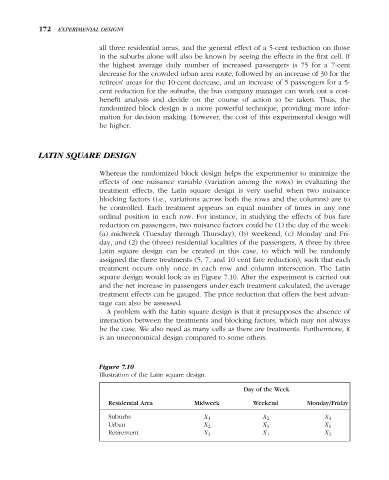
                             day, and (2) the (three) residential localities of the passengers. A three by three
                             Latin square design can be created in this case, to which will be randomly
                             assigned the three treatments (5, 7, and 10 cent fare reduction), such that each
                             treatment occurs only once in each row and column intersection. The Latin
                             square design would look as in Figure 7.10. After the experiment is carried out
                             and the net increase in passengers under each treatment calculated, the average
                             treatment effects can be gauged. The price reduction that offers the best advan-
                             tage can also be assessed.
                               A problem with the Latin square design is that it presupposes the absence of
                             interaction between the treatments and blocking factors, which may not always
                             be the case. We also need as many cells as there are treatments. Furthermore, it
                             is an uneconomical design compared to some others.


                             Figure 7.10
                             Illustration of the Latin square design.

                                                                     Day of the Week
                               Residential Area        Midweek         Weekend        Monday/Friday

                               Suburbs                   X 1              X 2              X 3
                               Urban                     X 2              X 3              X 1
                               Retirement                X 3              X 1              X 2

