


Page 187 - [Uma_Sekaran]_Research_methods_for_business__a_sk(BookZZ.org)
P. 187
RANDOMIZED BLOCK DESIGN  171

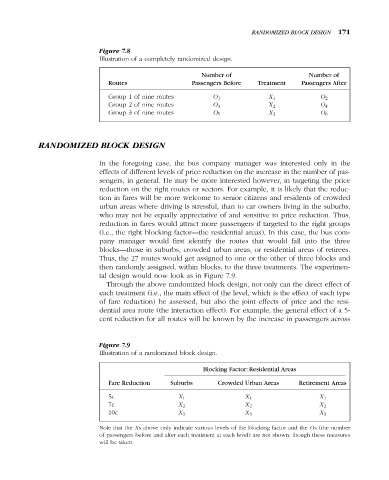
                             Figure 7.8
                             Illustration of a completely randomized design.
                                                         Number of                     Number of
                               Routes                 Passengers Before  Treatment   Passengers After
                               Group 1 of nine routes       O 1            X 1            O 2
                               Group 2 of nine routes       O 3            X 2            O 4
                               Group 3 of nine routes       O 5            X 3            O 6


            RANDOMIZED BLOCK DESIGN

                             In the foregoing case, the bus company manager was interested only in the
                             effects of different levels of price reduction on the increase in the number of pas-
                             sengers, in general. He may be more interested however, in targeting the price
                             reduction on the right routes or sectors. For example, it is likely that the reduc-
                             tion in fares will be more welcome to senior citizens and residents of crowded
                             urban areas where driving is stressful, than to car owners living in the suburbs,
                             who may not be equally appreciative of and sensitive to price reduction. Thus,
                             reduction in fares would attract more passengers if targeted to the right groups
                             (i.e., the right blocking factor—the residential areas). In this case, the bus com-
                             pany manager would first identify the routes that would fall into the three
                             blocks—those in suburbs, crowded urban areas, or residential areas of retirees.
                             Thus, the 27 routes would get assigned to one or the other of three blocks and
                             then randomly assigned, within blocks, to the three treatments. The experimen-
                             tal design would now look as in Figure 7.9.
                               Through the above randomized block design, not only can the direct effect of
                             each treatment (i.e., the main effect of the level, which is the effect of each type
                             of fare reduction) be assessed, but also the joint effects of price and the resi-
                             dential area route (the interaction effect). For example, the general effect of a 5-
                             cent reduction for all routes will be known by the increase in passengers across


                             Figure 7.9
                             Illustration of a randomized block design.

                                                         Blocking Factor: Residential Areas
                               Fare Reduction   Suburbs      Crowded Urban Areas    Retirement Areas
                               5c                 X 1                X 1                  X 1
                               7c                 X 2                X 2                  X 2
                               10c                X 3                X 3                  X 3

                             Note that the Xs above only indicate various levels of the blocking factor and the Os (the number
                             of passengers before and after each treatment at each level) are not shown, though these measures
                             will be taken.

