


Page 85 - Computer Basics - Research
P. 85
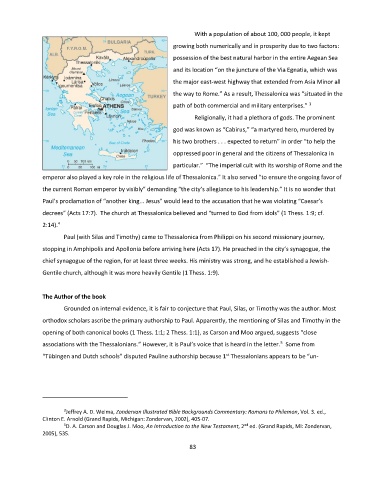
With a population of about 100, 000 people, it kept

                                                            growing both numerically and in prosperity due to two factors:
                                                            possession of the best natural harbor in the entire Aegean Sea

                                                            and its location “on the juncture of the Via Egnatia, which was
                                                            the major east-west highway that extended from Asia Minor all

                                                            the way to Rome.” As a result, Thessalonica was “situated in the
                                                                                                         3
                                                            path of both commercial and military enterprises.”
                                                                   Religionally, it had a plethora of gods. The prominent
                                                            god was known as “Cabirus,” “a martyred hero, murdered by

                                                            his two brothers . . . expected to return” in order “to help the
                                                            oppressed poor in general and the citizens of Thessalonica in

                                                            particular.”  “The imperial cult with its worship of Rome and the
               emperor also played a key role in the religious life of Thessalonica.” It also served “to ensure the ongoing favor of

               the current Roman emperor by visibly” demanding “the city’s allegiance to his leadership.” It is no wonder that
               Paul’s proclamation of “another king... Jesus” would lead to the accusation that he was violating “Caesar’s

               decrees” (Acts 17:7).  The church at Thessalonica believed and “turned to God from idols” (1 Thess. 1:9; cf.
               2:14).
                     4
                       Paul (with Silas and Timothy) came to Thessalonica from Philippi on his second missionary journey,

               stopping in Amphipolis and Apollonia before arriving here (Acts 17). He preached in the city’s synagogue, the
               chief synagogue of the region, for at least three weeks. His ministry was strong, and he established a Jewish-
               Gentile church, although it was more heavily Gentile (1 Thess. 1:9).


               The Author of the book
                       Grounded on internal evidence, it is fair to conjecture that Paul, Silas, or Timothy was the author. Most

               orthodox scholars ascribe the primary authorship to Paul. Apparently, the mentioning of Silas and Timothy in the
               opening of both canonical books (1 Thess. 1:1; 2 Thess. 1:1), as Carson and Moo argued, suggests “close

               associations with the Thessalonians.” However, it is Paul’s voice that is heard in the letter.   Some from
                                                                                                5
               “Tübingen and Dutch schools” disputed Pauline authorship because 1  Thessalonians appears to be “un-
                                                                             st


                       3 Jeffrey A. D. Weima, Zondervan Illustrated Bible Backgrounds Commentary: Romans to Philemon, Vol. 3. ed.,
               Clinton E. Arnold (Grand Rapids, Michigan: Zondervan, 2002), 405-07.
                                                                                    nd
                       5 D. A. Carson and Douglas J. Moo, An Introduction to the New Testament, 2  ed. (Grand Rapids, MI: Zondervan,
               2005), 535.
                                                                 83

