


Page 86 - Computer Basics - Research
P. 86
6
           theological in content” and does not attack “legalism.”  Paul’s emphasis in the book is to discuss in detail the
           doctrine of eschatology (1 Thess. 4:13—5:11; cf. 2 Thess. 2:1-17).
                  The fact that there is nothing written in the epistle about legalism strongly suggests that legalism was not

           an issue among the newly found church.
                  In some other translations, the names Silas and Silvanus are often used interchangeably. Tenney suggests

           that Silas (Σιλ�ας [Silas]) is the contraction of Silouanos (Σιλουανός [Silouanos]), who was a famous member of
           the Jerusalem church (Acts 15:22, 23) and companion of Paul on his second missionary journey (Acts 15—18).

                                                                7
           “Silvanus,” however, “could be the Latinized form of Silas.”  He was sent to Antioch from Jerusalem together
           with Judas called Barsabbas as leading men among brothers (Acts 15:21-23) to deliver the letter of verdict

           concerning authenticity of Gentiles’ salvation “through the grace of the Lord Jesus” (Acts 15:11). Both Judas and
           Silas returned to Jerusalem (Acts 15:33).   Silas, it appears, went back to Antioch and was commissioned by Paul

           (Acts 15:40) to come with him during his missionary journeys (Acts15:36—18:22).


           Background History
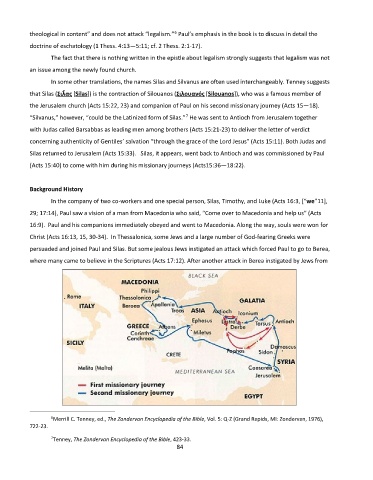
                  In the company of two co-workers and one special person, Silas, Timothy, and Luke (Acts 16:3, [“we”11],

           29; 17:14), Paul saw a vision of a man from Macedonia who said, “Come over to Macedonia and help us” (Acts
           16:9).  Paul and his companions immediately obeyed and went to Macedonia. Along the way, souls were won for

           Christ (Acts 16:13, 15, 30-34).  In Thessalonica, some Jews and a large number of God-fearing Greeks were

           persuaded and joined Paul and Silas. But some jealous Jews instigated an attack which forced Paul to go to Berea,
           where many came to believe in the Scriptures (Acts 17:12). After another attack in Berea instigated by Jews from


                  6 Merrill C. Tenney, ed., The Zondervan Encyclopedia of the Bible, Vol. 5: Q-Z (Grand Rapids, MI: Zondervan, 1976),
           722-23.

                  7 Tenney, The Zondervan Encyclopedia of the Bible, 423-33.
                                                             84

