


Page 35 - Think 3. Teacher's Book B3+
P. 35
Unit 2
          A hard life                        Reading; Train to                ; Speaking


           Culture notes                          THEY MADE                                        A HARD LIFE  UNIT 2
           The Reverend James Ramsay was
           a ship’s surgeon, Anglican priest and   A DIFFERENCE
           leading abolitionist. Born in 1733 in
           Scotland, he joined the Navy at the
           age of 24. He was hugely influential    THE SLAVE TRADE
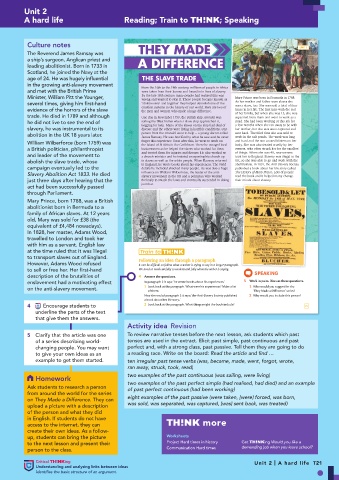
           in the growing anti-slavery movement    From the 16th to the 19th century, millions of people in Africa
           and met with the British Prime          were taken from their homes and forced into lives of slavery.
           Minister, William Pitt the Younger,     By the late 18th century many people had realised this was   Mary Prince was born in Bermuda in 1788.
                                                   wrong and wanted to stop it. These people became known as
           several times, giving him first-hand    ‘abolitionists’ and together they helped demolish one of the   As her mother and father were slaves she
                                                                                    was a slave, too. She was sold a total of four
           evidence of the horrors of the slave    cruellest systems in the history of our world. Here are two of   times in her life. The first time with the rest
                                                   the men and women who made a huge difference.
           trade. He died in 1789 and although     One day in November 1759, the British ship Arundel was   of her family, but when she was 12, she was
                                                                                    separated from them and went to work as a
           he did not live to see the end of       sailing the West Indies when a slave ship approached it,   maid. She had been working at this job for
                                                   begging for help. Many of the slaves on the ship had died of
                                                                                    a few months when she ran away to be with
           slavery, he was instrumental to its     disease and the others were living in horrible conditions. One   her mother, but she was soon captured and
           abolition in the UK 18 years later.     person from the Arundel went to help – a young doctor called   sent back. The third time she was sold to
                                                                                    work in the salt ponds. The work was long
                                                   James Ramsay. He was horrified by what he saw and he never
           William Wilberforce (born 1759) was     forgot this experience. Soon after this, he went to work on   and hard and the sun caused blisters on her
                                                                                    body. She was also treated cruelly by her
                                                   the island of St Kitts in the Caribbean. There he enraged local
           a British politician, philanthropist    businessmen as he helped the slaves who worked for them   owners, who often struck her for the smallest
           and leader of the movement to           and treated them for injuries and disease. He also worked as   of things. When she was 40, new owners
                                                   a church minister and he insisted on opening his church up
                                                                                    took her to England. Slavery was illegal in the
           abolish the slave trade, whose          to slaves as well as the white people. When Ramsay returned   UK, so she was able to go and work with the
                                                                                    abolitionists. In 1831, the Anti-Slavery Society
                                                   to England, he wrote books about his experiences. The vivid
           campaign eventually led to the          details he included shocked many people. He was also a huge   published a book about her life story called
           Slavery Abolition Act 1833. He died     influence on William Wilberforce, the leader of the anti-  The History of Mary Prince. Lots of people
                                                                                    read the book and it helped many change
                                                   slavery movement in the UK and a politician who worked
           just three days after hearing that the   tirelessly to smash the laws and eventually succeeded in doing   their minds about slavery.
                                                   just that.
           act had been successfully passed        just that.
           through Parliament.
           Mary Prince, born 1788, was a British
           abolitionist born in Bermuda to a
           family of African slaves. At 12 years
           old, Mary was sold for £38 (the
           equivalent of £4,484 nowadays).
           In 1828, her master, Adams Wood,
           travelled to London and took her
           with him as a servant. English law
           at the time ruled that it was illegal
           to transport slaves out of England.
           However, Adams Wood refused            Following an idea through a paragraph
                                                  It can be difficult to follow what a writer is trying to say in a longer paragraph.
           to sell or free her. Her first-hand    We need to read carefully to understand fully what the writer is saying.
           description of the brutalities of      4  Answer the questions.                SPEAKING
           enslavement had a motivating effect      In paragraph 2 it says: ‘he wrote books about his experiences.’  5  Work in pairs. Discuss these questions.
           on the anti-slavery movement.            1  Look back at the paragraph. What were his experiences? Make a list   1  Who would you suggest for the
                                                     of them.
                                                                                          ‘They Made a Difference’ series?
                                                    Near the end of paragraph 3 it says: ‘the Anti-Slavery Society published   2  Why would you include this person?
                                                    a book about her life story.’
           4     Encourage students to              2  Look back at the paragraph. What things might the book include?  21
             underline the parts of the text
             that give them the answers.
                                              Activity idea  Revision
           5  Clarify that the article was one   To review narrative tenses before the next lesson, ask students which past
             of a series describing world-    tenses are used in the extract. Elicit past simple, past continuous and past
             changing people. You may want    perfect and, with a strong class, past passive. Tell them they are going to do
             to give your own ideas as an     a reading race. Write on the board: Read the article and find …
             example to get them started.     ten irregular past tense verbs (was, became, made, went, forgot, wrote,
                                              ran away, struck, took, read)
              Homework                        two examples of the past continuous (was sailing, were living)
           Ask students to research a person   two examples of the past perfect simple (had realised, had died) and an example
                                              of past perfect continuous (had been working)
           from around the world for the series
           on They Made a Difference. They can   eight examples of the past passive (were taken, [were] forced, was born,
           upload a picture with a description   was sold, was separated, was captured, [was] sent back, was treated)
           of the person and what they did
           in English. If students do not have
           access to the internet, they can                             more
           create their own ideas. As a follow-
           up, students can bring the picture               Worksheets
           to the next lesson and present their             Project Hard times in history  Get   ing Would you like a
           person to the class.                             Communication Hard times  demanding job when you leave school?

              Critical   ing                                                               Unit 2 | A hard life T21
              Understanding and analysing links between ideas
              Identifies the basic structure of an argument.

