


Page 38 - Think 3. Teacher's Book B3+
P. 38
Unit 2
           A hard life                      Reading


          Warmer
          Write on the board: What do you
          know about life in your country in the    READING
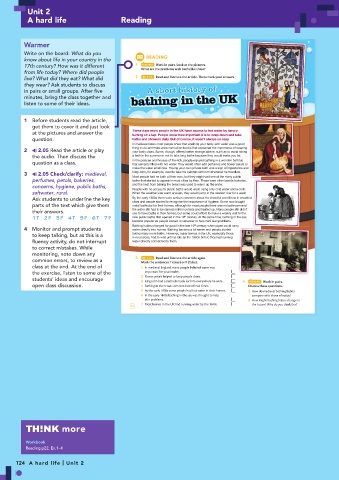
          17th century? How was it different     1   SPEAKING   Work in pairs. Look at the pictures.
                                                   SPEAKING
          from life today? Where did people        What are the problems with baths like these?
          live? What did they eat? What did      2   2.05   Read and listen to the article. Then check your answers.
          they wear? Ask students to discuss
          in pairs or small groups. After five        A short history of
                                               bathing in the UK
                                               bathing in the UK
                                               bathing in the UK
                                               bathing in the UK
                                               bathing in the UK
                                               bathing in the UK
                                               bathing in the UK
                                               bathing in the UK
                                               bathing in the UK
                                               bathing in the UK
                                               bathing in the UK
                                               bathing in the UK
                                               bathing in the UK
                                               bathing in the UK
                                               bathing in the UK
                                               bathing in the UK
                                               bathing in the UK
                                               bathing in the UK
                                               bathing in the UK
                                               bathing in the UK
                                               bathing in the UK
                                               bathing in the UK
                                               bathing in the UK
                                               bathing in the UK
                                               bathing in the UK
                                               bathing in the UK
                                               bathing in the UK
          minutes, bring the class together and   bathing in the UK
          listen to some of their ideas.
          1  Before students read the article,
            get them to cover it and just look
            at the pictures and answer the     These days most people in the UK have access to hot water by simply
                                               turning on a tap. People know how important it is to keep clean and take
            question.                          baths and showers daily. But of course, it wasn’t always so easy.
                                               In medieval times most people knew that washing your body with water was a good
          2    2.05 Read the article or play   thing to do and there were instruction books that explained the importance of keeping
                                               your body clean. Some, though, offered rather strange advice, such as to avoid taking
            the audio. Then discuss the        a bath in the summer or not to take long baths because they would make you fat.
            question as a class.               In the palaces and houses of the rich, people enjoyed bathing in a wooden bathtub
                                               that servants filled with hot water. They would often add perfumes and flower petals to
                                               make the water smell nice. Having your own private bath was a sign of importance and
                                               make the water smell nice. Having your own private bath was a sign of importance and
          3    2.05 Check/clarify: medieval,   King John, for example, used to take his bathtub with him whenever he travelled.
                                               Most people had no bath of their own, but they might visit one of the many public
            perfumes, petals, bakeries,        baths that started to appear in most cities by then. These were often beside bakeries,
            concerns, hygiene, public baths,   and the heat from baking the bread was used to warm up the water.
                                               People with no access to public baths would wash using only cold water and a cloth.
            saltwater, rural.                  When the weather was warm enough, they would jump in the nearest river for a wash.
            Ask students to underline the key   By the early 1800s there were serious concerns about the dreadful conditions in crowded
                                               cities and people started to recognise the importance of hygiene. Some now bought
            parts of the text which give them   metal bathtubs for their homes, although for most people there was no bathroom and
            their answers.                     the water still had to be carried in from outside and heated up. Many people still didn’t
                                               use to have baths in their homes, but some could afford to make a weekly visit to the
            1 T   2 F   3 F   4 T   5 F   6 T   7 F  new public baths that opened in the 19 th  century. At the same time, bathing in the sea
                                               became popular as people looked to saltwater to help cure skin problems.
                                               Bathing habits changed for good in the late 19 th  century when pipes could carry  century when pipes could carry
          4  Monitor and prompt students       water directly into homes. Bathing became a lot easier and people started
            to keep talking, but as this is a   taking many more baths. However, many homes in the UK, especially those
                                               in rural areas, had to wait until as late as the 1960s before they had running
            fluency activity, do not interrupt   water directly connected to them.
            to correct mistakes. While
            monitoring, note down any
                                                     2.05   Read and listen to the article again.
            common errors, to review as a        3   Mark the sentences T (true) or F (false).
            class at the end. At the end of        1  In medieval England many people believed water was
            the exercise, listen to some of the     important for your health.
            students’ ideas and encourage          2  Flower petals helped to keep people clean.   4   SPEAKING   Work in pairs.
                                                   3  King John had a bathtub made for him everywhere he went.
                                                                                         SPEAKING
            open class discussion.                 4  Bathing in rivers was common in medieval times.   Discuss these questions.
                                                   5  By the early 1800s some people had hot water in their homes.   1  How do medieval bathing habits
                                                   6  In the early 1800s bathing in the sea was thought to help   compare with those of today?
                                                    skin problems.                      2  How might bathing habits change in
                                                   7  Most homes in the UK had running water by the 1940s.   the future? Why do you think this?
                                               24
                       more
          Workbook
          Reading p22, Ex.1–4

       T24  A hard life | Unit 2

