


Page 46 - Think 3. Teacher's Book B3+
P. 46
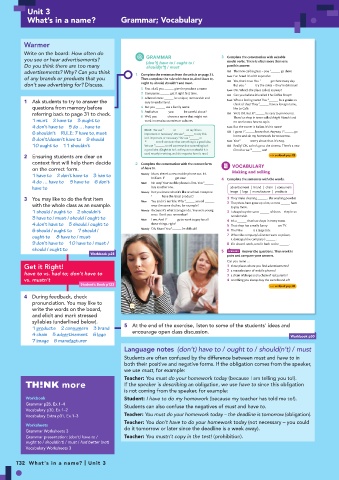
Unit 3
           What’s in a name?                Grammar; Vocabulary


          Warmer
          Write on the board: How often do
          you see or hear advertisements?           GRAMMAR                    3  Complete the conversation with suitable
                                                                                 modal verbs. There is often more than one
          Do you think there are too many           (don’t) have to / ought to /   possible answer.
                                                    should(n’t) / must
          advertisements? Why? Can you think     1  Complete the sentences from the article on page 31.   Gill  The new café is great – you  1     go there.
          of any brands or products that you       Then complete the rule with have to, don’t have to,   Jack I’ve heard it’s a bit expensive.  go there every day.
                                                                                 Gill  Yes, that’s true. You
                                                                                            2
          don’t see advertising for? Discuss.      ought to, should, shouldn’t and must.  But you  3     try the cakes – they’re delicious!
                                                   1  First of all, you      give the product a name.  Jack OK. What’s the place called, anyway?
                                                   2  Companies      get it right first time.  Gill  Can you believe it’s called The Coffee Shop?!
                                                   3  A brand name      be unique, memorable and   4
                                                                                                    be a genius to
          1  Ask students to try to answer the      easy to understand.          Jack What a boring name! You    have a foreign name,
                                                                                   think of that! They
                                                                                            5
            questions from memory before           4  But you      use a family name.  like Le Café.
                                                             you
                                                                  be careful about?
            referring back to page 31 to check.    5  And what      choose a name that might not   Gill  Well, OK. But it  6     be easy to pronounce.
                                                   6  Well, you
            1 must   2 have to   3 ought to         work in certain countries or cultures.  There’s a shop in town called Arighi Bianchi and
                                                                                   no one knows how to say it.
            4 don’t have to   5 do … have to                                     Jack But the owner is Italian. It’s his name!
            6 shouldn’t   RULE: 7 have to, must     RULE:  We use  7     or      to say ‘this is   Gill  I guess I  7     know that. Anyway, I  8     go
                                                    important or necessary’. We use  8
                                                                      to say ‘this
                                                                                   home and do my homework for tomorrow.
            8 don’t/doesn’t have to   9 should      isn’t important or necessary’. We use  9     or   Jack You  9     worry about that. It’s easy.
                                                    10
                                                         to tell someone that something is a good idea.
            10 ought to   11 shouldn’t              We use  11     to tell someone that something isn’t   Gill  Really? OK, so let’s go to the cinema. There’s a new
                                                    a good idea. (Ought to isn’t as frequent as should. It is   film that we  10     see!
                                                    used mostly in writing, and the negative form is rare.)
          2  Ensuring students are clear on                                                       workbook page 28
            context first will help them decide   2  Complete the conversation with the correct form
            on the correct form.                   of have to.                     VOCABULARY
            1 have to   2 don’t have to   3 has to       Mandy  Mum, there’s a new mobile phone out. It’s   Making and selling
                                                           1
                                                      brilliant. I
                                                               get one!
            4 do … have to    5 have to   6 don’t   Mum   No way! Your mobile phone is fine. You  2       4  Complete the sentences with the words.
            have to                                   buy another one.            advertisement |  brand |  chain |  consumers
                                                   Mandy  But you know what it’s like at school. Everyone   image |  logo |  manufacturer |  products
                                                      3     have the latest product!
          3  You may like to do the first item     Mum   Yes, and it’s terrible. Why  4     you all        1  They make cleaning      , like washing powder.
            with the whole class as an example.       wear the same clothes, for example?  2  The prices have gone up a lot, so now      have
                                                                                  to pay more.
            1 should / ought to   2 shouldn’t      Mandy  Because it’s what teenagers do. You were young   3  I always buy the same      of shoes – they’re so
                                                      once. Don’t you remember?
                                                                                  comfortable.
            3 have to / must / should / ought to     Mum   I see. And I  5     go to work to pay for all   4  It’s a      that has shops in every town.
            4 don’t have to   5 should / ought to     these things, right?       5  That shop has a really funny      on TV.
            6 should / ought to    7 should /      Mandy  Oh, Mum! You  6     be difficult!  6  The Nike      is a large tick.
            ought to    8 have to / must                                         7  When the company’s director went to prison,
                                                                                  it damaged the company’s
                                                                                                   .

            9 don’t have to   10 have to / must /                                8  If it doesn’t work, send it back to the      .
            should / ought to                                                  5   SPEAKING   Answer the questions. Then work in
                                                                                 SPEAKING
                                 Workbook p28                                    pairs and compare your answers.
                                                                                 Can you name …
          Get it Right!                                                          1  three places where you find advertisements?
          have to vs. had to; don’t have to                                      2  a manufacturer of mobile phones?
                                                                                 3  a chain of shops and a chain of restaurants?
          vs. mustn’t                                                            4  one thing you always buy the same brand of?
                             Student’s Book p123                                                  workbook page 30
          4  During feedback, check
            pronunciation. You may like to
            write the words on the board,      32
            and elicit and mark stressed
            syllables (underlined below).
            1 products   2 consumers   3 brand     5  At the end of the exercise, listen to some of the students’ ideas and
            4 chain   5 advertisement   6 logo    encourage open class discussion.                     Workbook p30
            7 image    8 manufacturer
                                             Language notes  (don’t) have to / ought to / should(n’t) / must
                                             Students are often confused by the difference between must and have to in
                                             both their positive and negative forms. If the obligation comes from the speaker,
                                             we use must, for example:
                                             Teacher: You must do your homework today (because I am telling you to!).
                       more                  If the speaker is describing an obligation, we use have to since this obligation
                                             is not coming from the speaker, for example:
          Workbook                           Student: I have to do my homework (because my teacher has told me to!).
          Grammar p28, Ex.1–4                Students can also confuse the negatives of must and have to.
          Vocabulary p30, Ex.1–2
          Vocabulary Extra p31, Ex.1–3       Teacher: You must do your homework today – the deadline is tomorrow (obligation).
                                             Teacher: You don’t have to do your homework today (not necessary – you could
          Worksheets                         do it tomorrow or later since the deadline is a week away).
          Grammar Worksheets 3
          Grammar presentation: (don’t) have to /   Teacher: You mustn’t copy in the test! (prohibition).
          ought to / should(n’t) / must / had better (not)
          Vocabulary Worksheets 3
       T32  What’s in a name? | Unit 3

