


Page 78 - Think 3. Teacher's Book B3+
P. 78
Units 5 & 6
           Towards B2 First for Schools


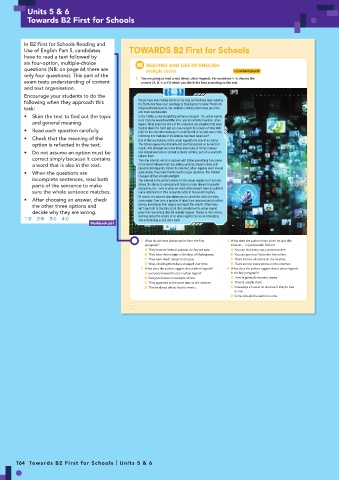
          In B2 First for Schools Reading and
          Use of English Part 5, candidates   TOWARDS B2 First for Schools
          have to read a text followed by
          six four-option, multiple-choice          READING AND USE OF ENGLISH
          questions (NB: on page 64 there are       Multiple choice                    workbook page 61
          only four questions). This part of the   1  You are going to read a text about urban legends. For questions 1–4, choose the
          exam tests understanding of content      answer (A, B, C or D) which you think fits best according to the text.
          and text organisation.
          Encourage your students to do the
          following when they approach this       People have been telling stories for as long as they have been walking
                                                  the Earth. And from cave paintings to Shakespeare’s Globe Theatre to
          task:                                   Hollywood blockbusters, the methods of telling them have got more
                                                  and more sophisticated.
          •  Skim the text to find out the topic   In the 1960s, a new storytelling art form emerged – the urban legend.
            and general meaning.                  Even if you’ve never heard the term, you’ve certainly heard an urban
                                                  legend. What about the story of the unwanted pet alligators that were
          •  Read each question carefully.        flushed down the toilet and are now living in the sewers of New York
                                                  City? Or the man who woke up in a bathtub full of ice and saw a note
                                                  informing him that one of his kidneys had been taken out?
          •  Check that the meaning of the        One of the key features of the urban legend is its lack of an author.
            option is reflected in the text.      The stories appear mysteriously and are then passed on by word of
                                                  mouth. And although we know these mini-tales of horror, humour
          •  Do not assume an option must be      and embarrassment are almost certainly not true, part of us wants to
            correct simply because it contains    believe them.
                                                  Then the internet, which is packed with fiction (everything from jokes
            a word that is also in the text.      to the latest releases from top-selling authors), helped create and
                                                  spread urban legends. Before the internet, urban legends went around
          •  When the questions are               quite slowly. They took time to reach a larger audience. The internet
            incomplete sentences, read both       changed all that almost overnight.
                                                  The internet is the perfect vehicle for the urban legend, for it not only
            parts of the sentence to make         allows the stories to spread much faster but also allows for greater
                                                  anonymity, too – a lot of what we read online doesn’t have an author’s
            sure the whole sentence matches.      name attached to it. This anonymity adds to the overall mystery.
                                                  Of course, the internet also allows you to check the truth of a story
          •  After choosing an answer, check      more easily. Over time, a number of sites have appeared which collect
            the other three options and           stories, investigate their origins and report the results. Often there
                                                  isn’t any truth to the story at all. But sometimes the urban legend
            decide why they are wrong.            grew from something that did actually happen. Thanks to the internet,
          1 D   2 B   3 C   4 C                   learning about the origins of an urban legend can be as interesting
                                                  and entertaining as the story itself.
                                 Workbook p61
                                                   1  What do we learn about stories from the first   3  What does the author mean when he says ‘the
                                                    paragraph?                    internet … is packed with fiction’?
                                                    A They’ve never been as popular as they are now.  A You can find every story written online.
                                                    B  They have their origins in the days of Shakespeare.  B  You can get most fiction for free online.
                                                    C They were much longer in the past.  C There are lots of stories on the internet.
                                                    D Ways of telling them have changed over time.  D There are too many stories on the internet.
                                                   2  What does the author suggest about urban legends?  4  What does the author suggest about urban legends
                                                    A Everyone knows the term ‘urban legend’.  in the last paragraph?
                                                    B  Everyone knows an example of one.  A They’re generally mystery stories.
                                                    C They appeared at the same time as the internet.  B  They’re usually short.
                                                    D They’re always about horrific events.  C Nowadays it’s easier to discover if they’re true
                                                                                   or not.
                                                                                  D Some include the author’s name.
                                               64


       T64  Towards B2 First for Schools | Units 5 & 6

