


Page 371 - JoFA_2022
P. 371
FRAUD / AUDITING


         The first-two digits of the population of                  was then “exploded” out into a half-million journal
         journal entries                                            entries per year, all below the auditors’ $5,000
                                                                    testing threshold.
                                                                      I ran a simulation to show that Benford’s
                                                                    Law-based testing could have detected a fraud
                                                                    scheme executed using below-the-testing-threshold
                                                                    dollar amounts, and I show the results below. In
                                                                    a real-world audit, the audit population would be
                                                                    all the journal entries posted from the date of the
                                                                    trial balance at the end of the prior year to the date
                                                                    of the trial balance in the current year. The testing
                                                                    objective would be to identify journal entries made
                                                                    in amounts below the testing threshold ($5,000 in
                                                                    HealthSouth’s case) that materially changed the
                                                                    ledger account balances and created a fraudulent set
                                                                    of financial statements.
                                                                      I used data from the annual journal entries of 29
                                                                    anonymous organizations. I analyzed the data for
                                                                    the organizations as if it were a single organization
                                                                    with 29 divisions. There were a total of 493,621
         Source: Mark Nigrini.                                      journal entry amounts. The first-two digits of the
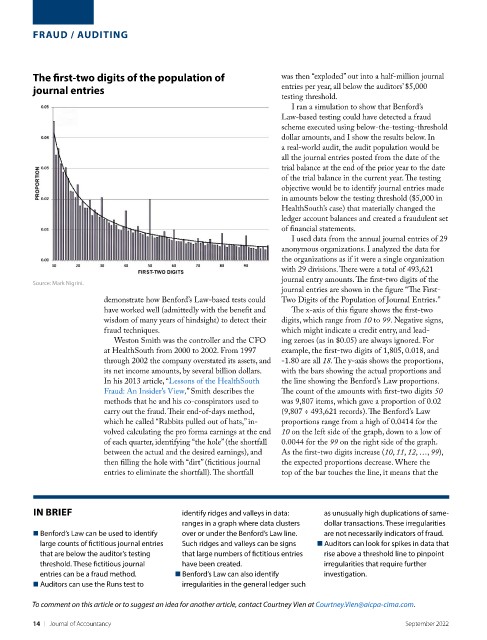
                                                                    journal entries are shown in the figure “The First-
                          demonstrate how Benford’s Law-based tests could   Two Digits of the Population of Journal Entries.”
                          have worked well (admittedly with the benefit and   The x-axis of this figure shows the first-two
                          wisdom of many years of hindsight) to detect their   digits, which range from 10 to 99. Negative signs,
                          fraud techniques.                         which might indicate a credit entry, and lead-
                            Weston Smith was the controller and the CFO   ing zeroes (as in $0.05) are always ignored. For
                          at HealthSouth from 2000 to 2002. From 1997   example, the first-two digits of 1,805, 0.018, and
                          through 2002 the company overstated its assets, and   -1.80 are all 18. The y-axis shows the proportions,
                          its net income amounts, by several billion dollars.   with the bars showing the actual proportions and
                          In his 2013 article, “Lessons of the HealthSouth   the line showing the Benford’s Law proportions.
                          Fraud: An Insider’s View,” Smith describes the   The count of the amounts with first-two digits 50
                          methods that he and his co-conspirators used to   was 9,807 items, which gave a proportion of 0.02
                          carry out the fraud. Their end-of-days method,   (9,807 ÷ 493,621 records). The Benford’s Law
                          which he called “Rabbits pulled out of hats,” in-  proportions range from a high of 0.0414 for the
                          volved calculating the pro forma earnings at the end   10 on the left side of the graph, down to a low of
                          of each quarter, identifying “the hole” (the shortfall   0.0044 for the 99 on the right side of the graph.
                          between the actual and the desired earnings), and   As the first-two digits increase (10, 11, 12, …, 99),
                          then filling the hole with “dirt” (fictitious journal   the expected proportions decrease. Where the
                          entries to eliminate the shortfall). The shortfall   top of the bar touches the line, it means that the


         IN BRIEF                           identify ridges and valleys in data:   as unusually high duplications of same-
                                            ranges in a graph where data clusters   dollar transactions. These irregularities
         ■  Benford’s Law can be used to identify   over or under the Benford’s Law line.   are not necessarily indicators of fraud.
          large counts of fictitious journal entries   Such ridges and valleys can be signs   ■  Auditors can look for spikes in data that
          that are below the auditor’s testing   that large numbers of fictitious entries   rise above a threshold line to pinpoint
          threshold. These fictitious journal   have been created.            irregularities that require further
          entries can be a fraud method.  ■  Benford’s Law can also identify   investigation.
         ■  Auditors can use the Runs test to   irregularities in the general ledger such
         To comment on this article or to suggest an idea for another article, contact Courtney Vien at Courtney.Vien@aicpa-cima.com.


         14    |   Journal of Accountancy                                                        September 2022

