


Page 372 - JoFA_2022
P. 372
Authentic journal entries with added
          Benford’s Law proportion and the actual propor-
                                                    fictitious amounts
          tion are almost equal. The conformity of the data to
          Benford’s Law can be measured by calculating the
          average of all the deviations (the spikes above the   Part 1: Added fictitious journal entries $2,000–$4,999
          Benford’s Law line and the gaps below the Ben-
                                                      0.05
          ford’s Law line). By this metric (called the mean
          absolute deviation) the conformity level is a little   Valley  Ridge               Valley
          better (the deviations or differences are slightly
                                                      0.04
          smaller) than what I’ve usually seen in populations
                                                                        Benford's Law
          of corporate journal entries.
            I chose to analyze the first-two digits, even
          though Benford’s Law is usually associated with   0.03
          the first digits of the amounts in tabulated data. I   PROPORTION
          did this because of the bluntness issue associated   0.02
          with the first digits and for reasons related to audit
          efficiency. First, individuals can fictitiously increase
          the dollar amount of a valid journal entry (impact-
                                                      0.01
          ing accuracy) by a reasonably large percentage
          that leaves the first digit unchanged. For example,
          $1,510, $2,204, and $3,100 can all be increased by
                                                      0.00
          28.5%, and the new inflated amounts will still have
                                                         10   20    30    40   50    60    70   80    90
          first digits of 1, 2, and 3, respectively. Second, a               FIRST-TWO DIGITS
          first-digit test will give audit samples that are large
          and inefficient. In the figure “The First Two-Digits   Part 2: Added more fictitious journal entries $2,000–$4,999
          of the Population of Journal Entries,” the first digit
          5 amounts (with first-two digits from 50 through   0.05
          to 59) are significantly overstated, and testing all
                                                          Valley      Ridge                  Valley
          the first digit 5 amounts would mean testing 8.9%
          of the population. The first digit 5 over is almost   0.04
          entirely explained by the spike (the excess) at 50,           Benford's Law
          and testing the first-two digit 50 amounts would
          mean testing only 2% of the population, a marked   0.03
          reduction in audit work.                   PROPORTION
            As the next step in simulating the Health-
          South fraud method, I added fictitious journal   0.02
          entries, all with dollar amounts from $2,000
          to $4,999, to the authentic data shown in the
          figure “The First-Two Digits of the Population of   0.01
          Journal Entries.” I chose these amounts because
          the fictitious entries in the HealthSouth fraud
          were all below $5,000, as the CFO knew that   0.00
                                                         10   20    30    40   50    60    70   80    90
          the auditors only tested journal entries of $5,000                 FIRST-TWO DIGITS
          and higher. I assumed that the fictitious entries                                     Source: Mark Nigrini.
          were evenly distributed from $2,000 to $4,999
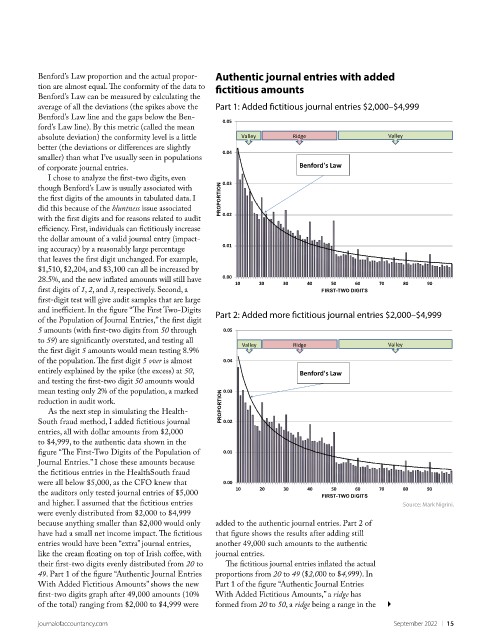
          because anything smaller than $2,000 would only   added to the authentic journal entries. Part 2 of
          have had a small net income impact. The fictitious   that figure shows the results after adding still
          entries would have been “extra” journal entries,   another 49,000 such amounts to the authentic
          like the cream floating on top of Irish coffee, with   journal entries.
          their first-two digits evenly distributed from 20 to   The fictitious journal entries inflated the actual
          49. Part 1 of the figure “Authentic Journal Entries   proportions from 20 to 49 ($2,000 to $4,999). In
          With Added Fictitious Amounts” shows the new   Part 1 of the figure “Authentic Journal Entries
          first-two digits graph after 49,000 amounts (10%   With Added Fictitious Amounts,” a ridge has
          of the total) ranging from $2,000 to $4,999 were   formed from 20 to 50, a ridge being a range in the

          journalofaccountancy.com                                                            September 2022    |   15

