


Page 375 - JoFA_2022
P. 375
FRAUD / AUDITING


         The first-two digits of the invoice amounts                data analytics will be at detecting a below-the-
                                                                    testing-threshold fraud scheme, provided that the
                                                                    follow-up audit work is done competently.
                                                                    BENFORD’S LAW-BASED AUDIT PLANNING
                                                                    AU-C Section 315, Understanding the Entity and
                                                                    Its Environment and Assessing the Risks of Material
                                                                    Misstatement, requires auditors to identify journal
                                                                    entries that might represent specific risks, including
                                                                    unusual transactions, events, amounts, ratios, and
                                                                    trends. Benford’s Law-based audit analytics can also
                                                                    be used to identify unusual transactions in journal
                                                                    entries, as I demonstrate in the following example.
                                                                      The data I used is a file of invoices processed
                                                                    for payment by an electricity supply company over
                                                                    a 16-month period. The file was made available to
                                                                    me for in-house training and for research purposes.
                                                                    There were 189,470 invoices processed for payment
                                                                    for a total of $490,277,625. About one-half of the
                                                                    total dollars went to pay the 370 invoices for invoice
                                                     Source: Mark Nigrini.
                                                                    amounts of $100,000 and higher. The first-two dig-
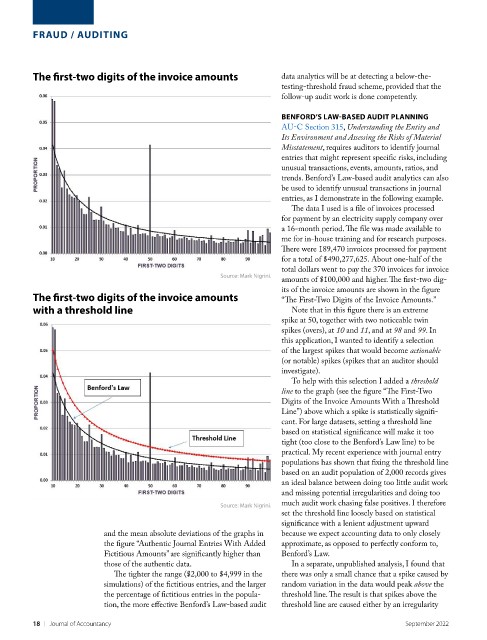
                                                                    its of the invoice amounts are shown in the figure
         The first-two digits of the invoice amounts                “The First-Two Digits of the Invoice Amounts.”
         with a threshold line                                        Note that in this figure there is an extreme
                                                                    spike at 50, together with two noticeable twin
                                                                    spikes (overs), at 10 and 11, and at 98 and 99. In
                                                                    this application, I wanted to identify a selection
                                                                    of the largest spikes that would become actionable
                                                                    (or notable) spikes (spikes that an auditor should
                                                                    investigate).
                                                                      To help with this selection I added a threshold
                                                                    line to the graph (see the figure “The First-Two
                                                                    Digits of the Invoice Amounts With a Threshold
                                                                    Line”) above which a spike is statistically signifi-
                                                                    cant. For large datasets, setting a threshold line
                                                                    based on statistical significance will make it too
                                                                    tight (too close to the Benford’s Law line) to be
                                                                    practical. My recent experience with journal entry
                                                                    populations has shown that fixing the threshold line
                                                                    based on an audit population of 2,000 records gives
                                                                    an ideal balance between doing too little audit work
                                                                    and missing potential irregularities and doing too
                                                     Source: Mark Nigrini.  much audit work chasing false positives. I therefore
                                                                    set the threshold line loosely based on statistical
                                                                    significance with a lenient adjustment upward
                          and the mean absolute deviations of the graphs in   because we expect accounting data to only closely
                          the figure “Authentic Journal Entries With Added   approximate, as opposed to perfectly conform to,
                          Fictitious Amounts” are significantly higher than   Benford’s Law.
                          those of the authentic data.                In a separate, unpublished analysis, I found that
                            The tighter the range ($2,000 to $4,999 in the   there was only a small chance that a spike caused by
                          simulations) of the fictitious entries, and the larger   random variation in the data would peak above the
                          the percentage of fictitious entries in the popula-  threshold line. The result is that spikes above the
                          tion, the more effective Benford’s Law-based audit   threshold line are caused either by an irregularity

         18    |   Journal of Accountancy                                                        September 2022

