


Page 28 - EH72
P. 28
26     EASTERN HORIZON  |  FACE TO FACE


           wholesome development. That is    and being with it in a caring, open,   Any final message on how
           one more reason why it is in our   and curious way. It differs from   modern day lay Buddhists can
           best interest to develop societies   vipassana in that there are no   truly practice the Dharma and
           that support everyone’s flourishing.  specific instructions to focus on   enjoy a good life?
                                             suffering, impermanence, and non-
           Meditation is a core practice in   self. Zen meditation and vipassana   I like to keep things simple. Be
           Buddhism. Is Zen meditation the   are alike in that there are often   kind and compassionate, not just
           same as mindfulness meditation?   moments of great peace, openness,   to others, but also to yourself.
           Basically, how does meditation    spaciousness, and heartfulness, but   Don’t expect perfection—just
           help us to live a good life?      in Zen we observe those moments   do your best in each moment.
                                             come and go without attachment.   Approach each situation, not from
           In my Zen lineage, meditation is   Zen meditation teaches us to be   the perspective of “what’s in it for
           committing to sitting still and paying   intimate with experience, to be   me?” or “what will I get out of it?”
           intimate attention to one’s heart/  present in each moment, to live life   but from the perspective of “what
           mind/body/environment as one      mindfully and heartfully, to notice   can I contribute than can make
           experiences it moment-by-moment.   our oneness with everything, to   things better?” Finally, remember
           While there is effort involved    accept what can’t be changed, and to   that being happy is not a matter
           in being still and maintaining    be grateful for our lives. It also helps   of owning more, consuming more,
           attention, there is also a lot of   us to understand that thoughts and   or being better than others, but is
           “letting be”—accepting what arises   emotions come and go but need not   the outcome of living wisely and
           without trying to make it different   be reacted to or acted upon.  virtuously.   EH


           What is Right


           Livelihood?


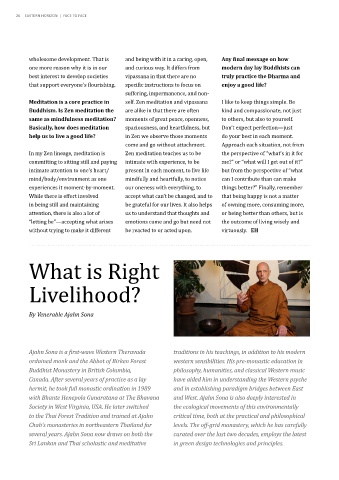
           By Venerable Ajahn Sona


           Ajahn Sona is a first-wave Western Theravada       traditions in his teachings, in addition to his modern
           ordained monk and the Abbot of Birken Forest       western sensibilities. His pre-monastic education in
           Buddhist Monastery in British Columbia,            philosophy, humanities, and classical Western music
           Canada. After several years of practice as a lay   have aided him in understanding the Western psyche
           hermit, he took full monastic ordination in 1989   and in establishing paradigm bridges between East
           with Bhante Henepola Gunaratana at The Bhavana     and West. Ajahn Sona is also deeply interested in
           Society in West Virginia, USA. He later switched   the ecological movements of this environmentally
           to the Thai Forest Tradition and trained at Ajahn   critical time, both at the practical and philosophical
           Chah’s monasteries in northeastern Thailand for    levels. The off-grid monastery, which he has carefully
           several years. Ajahn Sona now draws on both the    curated over the last two decades, employs the latest
           Sri Lankan and Thai scholastic and meditative      in green design technologies and principles.

