


Page 52 - MNLGA Free State Winter 2025
P. 52
GROWING WITH EDUCATION (Continued)                                         sun to dappled shade and grow best
                                                                                   in rich moist loam but are adaptable
                                                                                   to living in drier and shady sites. The
                                                                                   star shaped tiny 1/4in white flowers
                                                                                   are set on 3–4-inch flat topped cyme
                                                                                   that matures into ½ fruit that is a
                                                                                   mixture of light green, pale yellow,
                                                                                   red pink before slowly changing
                                                                                   to blue-black in the fall. The glossy
                                                                                   2-4-inch-long dark green leaves start
                                                                                   out as soft yellow green changing in
                                                                                   the autumn to orange to purplish
                                                                                   red. The leaves have a rounded base
                                                                                   and are finely toothed; the petiole is
                                                                                   mostly winged with a wavy margin.
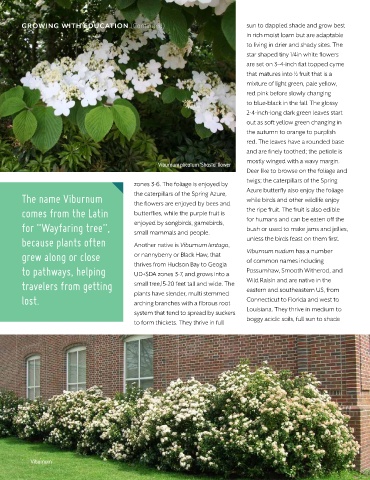
                                                     Viburnum plicatum ‘Shasta’ flower
                                                                                   Deer like to browse on the foliage and
                                                                                   twigs; the caterpillars of the Spring
                                             zones 3-6. The foliage is enjoyed by   Azure butterfly also enjoy the foliage

        The name Viburnum                    the caterpillars of the Spring Azure,   while birds and other wildlife enjoy
                                             the flowers are enjoyed by bees and
        comes from the Latin                 butterflies, while the purple fruit is   the ripe fruit. The fruit is also edible
                                                                                   for humans and can be eaten off the
        for “Wayfaring tree”,                enjoyed by songbirds, gamebirds,      bush or used to make jams and jellies,
                                             small mammals and people.
        because plants often                 Another native is Viburnum lentago,   unless the birds feast on them first.


        grew along or close                  or nannyberry or Black Haw, that      Viburnum nudum has a number
                                                                                   of common names including
        to pathways, helping                 thrives from Hudson Bay to Geogia     Possumhaw, Smooth Witherod, and
                                             UD+SDA zones 3-7, and grows into a
        travelers from getting               small tree,15-20 feet tall and wide. The   Wild Raisin and are native in the
                                                                                   eastern and southeastern US, from
        lost.                                plants have slender, multi stemmed    Connecticut to Florida and west to
                                             arching branches with a fibrous root
                                             system that tend to spread by suckers   Louisiana. They thrive in medium to
                                             to form thickets. They thrive in full   boggy acidic soils, full sun to shade


           Viburnum

