


Page 53 - MNLGA Free State Winter 2025
P. 53
and cold tolerant in USDA zones      zones 3-9. The trunk of the
        5-9. Plants grow as a rounded, multi-  tree is crooked, and the root
        stemmed upright and spreading        system is a branching woody
        shrub, 5-12 feet tall and wide. This   taproot. These plants are native
        lovely native has lovely, fragrant tiny   in eastern and central North
        star shaped flowers that sit on a 2–5-  America, from New York and
        inch flat-toped clusters in spring.   Connecticut to Illinois and
        Pollinators, including butterflies, thrive   south to Georgia and Texas.
        on the nectar. Flowers mature into   The foliage is host to Spring/
        clusters of round berry like fruit that   Summer Azure caterpillars
        change color as they ripen, light pink   while butterflies, bees and
        to deep pink to blue then purplish   other pollinator flock to the
        black. Although the fruit is edible, it   delightful fragrant flowers that
        is highly acidic and can be used to   are arranged in 4-5 clusters.
        make jam. The acidity of the fruit does   The flowers mature into edible
        not seem to matter to the songbirds,   1/3 inch oval fruit that are a mix
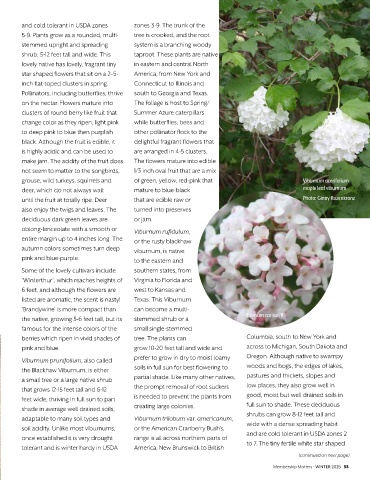
        grouse, wild turkeys, squirrels and   of green, yellow, red-pink that                        Viburnum acerifolium
        deer, which do not always wait       mature to blue-black                                    maple leaf viburnum
        until the fruit at totally ripe. Deer   that are edible raw or                               Photo: Ginny Rozenkranz
        also enjoy the twigs and leaves. The   turned into preserves
        deciduous dark green leaves are      or jam.
        oblong-lanceolate with a smooth or   Viburnum rufidulum,
        entire margin up to 4 inches long. The   or the rusty blackhaw
        autumn colors sometimes turn deep    viburnum, is native
        pink and blue-purple.                to the eastern and

        Some of the lovely cultivars include   southern states, from
        ‘Winterthur’, which reaches heights of   Virginia to Florida and
        6 feet, and although the flowers are   west to Kansas and
        listed are aromatic, the scent is nasty!   Texas. This Viburnum
        ‘Brandywine’ is more compact than    can become a multi-
                                                                                  Iburnum carlesii fl
        the native, growing 5-6 feet tall, but its   stemmed shrub or a
        famous for the intense colors of the   small single-stemmed
        berries which ripen in vivid shades of   tree. The plants can              Columbia, south to New York and
        pink and blue.                       grow 10-20 feet tall and wide and     across to Michigan, South Dakota and

        Viburnum prunifolium, also called    prefer to grow in dry to moist loamy   Oregon. Although native to swampy
        the Blackhaw Viburnum, is either     soils in full sun for best flowering to   woods and bogs, the edges of lakes,
        a small tree or a large native shrub   partial shade. Like many other natives,   pastures and thickets, slopes and
        that grows 12-15 feet tall and 6-12   the prompt removal of root suckers   low places, they also grow well in
        feet wide, thriving in full sun to part   is needed to prevent the plants from   good, moist but well drained soils in
        shade in average well drained soils,   creating large colonies.            full sun to shade. These deciduous
        adaptable to many soil types and     Viburnum trilobum var. americanum,    shrubs can grow 8-12 feet tall and
        soil acidity. Unlike most viburnums,   or the American Cranberry Bush’s,   wide with a dense spreading habit
        once established it is very drought   range is all across northern parts of   and are cold tolerant in USDA zones 2
        tolerant and is winter hardy in USDA   America, New Brunswick to British   to 7. The tiny fertile white star shaped
                                                                                                    (continued on next page)

                                                                                             Membership Matters • WINTER 2025   53

