


Page 119 - Destaco - Clamping Technology
P. 119
FO, FL, G Series


                                                        Variable Stroke Straight Line Action Clamps | Operation


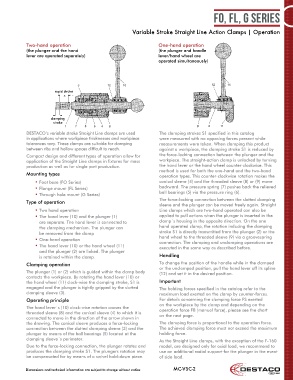
            Two-hand operation                                     One-hand operation
            (the plunger and the hand                              (the plunger and handle
            lever are operated separately)                         lever/hand wheel are
                                                                   operated simultaneously)


                        rapid stroke


                      clamping
                       stroke

            DESTACO‘s variable stroke Straight Line clamps are used   The clamping strokes S1 specified in this catalog
            in applications where workpiece thicknesses and workpiece   were measured with no opposing forces present while
            tolerances vary. These clamps are suitable for clamping   measurements were taken. When clamping this product
            between ribs and hollow spaces difficult to reach.      against a workpiece, the clamping stroke S1 is reduced by
            Compact design and different types of operation allow for   the force-locking connection between the plunger and the
            application of the Straight Line clamps in fixtures for mass   workpiece. The straight-action clamp is unlocked by turning
            production as well as for single part production.       the hand lever or the hand wheel counter-clockwise. This
                                                                    method is used for both the one-hand and the two-hand
            Mounting types                                          operation types. This counter-clockwise rotation makes the
                •   Foot base (FO Series)                           conical sleeve (4) and the threaded sleeve (8) or (9) move
                •  Flange mount (FL Series)                         backward. The pressure spring (7) pushes back the relieved
                •  Through hole mount (G Series)                    ball bearings (5) via the pressure ring (6).
                                                                    The force-locking connection between the slotted clamping
            Type of operation
                                                                    sleeve and the plunger can be moved freely again. Straight
                •     Two hand operation                            Line clamps which are two-hand operated can also be
                •   The hand lever (10) and the plunger (1)         applied to pull actions when the plunger is inserted in the
                 are separate. The hand lever is connected to       clamp´s housing in the opposite direction. On the one
                 the clamping mechanism. The plunger can            hand operated clamp, the rotation inducing the clamping
                 be removed from the clamp                          stroke S1 is directly transmitted from the plunger (2) or the
                •   One-hand operation                              hand wheel to the threaded sleeve (9) via a groovespring
                                                                    connection. The clamping and unclamping operations are
                •   The hand lever (10) or the hand wheel (11)      executed in the same way as described before.
                 and the plunger (2) are linked. The plunger
                 is retained within the clamp.                      Handling
            Clamping operation                                      To change the position of the handle while in the clamped
                                                                    or the unclamped position, pull the hand lever off its spline
            The plunger (1) or (2) which is guided within the clamp body   (12) and set it in the desired position.
            contacts the workpiece. By rotating the hand lever (10) or
            the hand wheel (11) clock-wise the clamping stroke, S1 is   Important
            engaged and the plunger is tightly gripped by the slotted       The holding forces specified in the catalog refer to the
            clamping sleeve (3).                                    maximum load exerted on the clamp by counter-forces.
            Operating principle                                     For details concerning the clamping force FS exerted
                                                                    on the workpiece by the clamp and depending on the
            The hand lever´s (10) clock-wise rotation causes the
            threaded sleeve (8) and the conical sleeve (4) to which it is   operation force FB (manual force), please see the chart
            connected to move in the direction of the arrow shown in   on the next page.
            the drawing. The conical sleeve produces a force-locking     The clamping force is proportional to the operation force.
            connection between the slotted clamping sleeve (3) and the   The achieved clamping force must not exceed the maximum
            plunger by means of the ball bearings (5) located at the   holding force.
            clamping sleeve´s perimeter.                                As the Straight Line clamps, with the exception of the F-160
            Due to the force-locking connection, the plunger rotates and   model, are designed only for axial load, we recommend to
            produces the clamping stroke S1. The plungers rotation may   use an additional radial support for the plunger in the event
            be compensated for by means of a swivel hold-down piece.   of side load.


            Dimensions and technical information are subject to change without notice  MC-VSC-2

