


Page 210 - Demo
P. 210
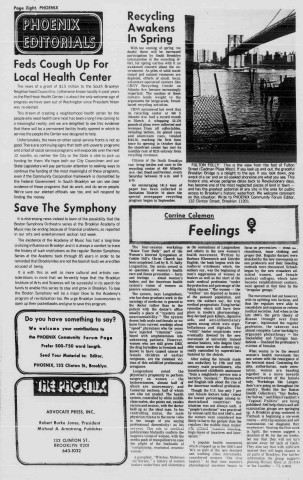
Page Eight, PHOENIXPJMHEMFeds Cough Up ForLocal Health CenterThe news of a grant of $1.5 million to the South Brooklyn Neighborhood Council Inc. (otherwise known locally in past years as the Red Hook Health Center) is about the only welcome sign of progress we have seen out of Washington since President Nixon was re-elected.This dream of creating a neighborhood health center for the people who need health care most has been a long time coming to a meaningful reality, and we are delighted to see this evidence that there will be a permanent facility finally opened in which to service the people the Center was designed to help.Unfortunately, the news on other social service fronts is not so good. There are continuing signs that both anti-poverty programs and a host of social service programs will evaporate over the next 12 months, as neither the City or the State is able to pick up funding for them. We hope both our City Councilman and our State Legislators will pay particular attention to seeking ways to continue the funding of the most meaningful of these programs, even if the Community Corporation framework is dismantled by the Federal Government. In South Brooklyn we can see clear evidence of those programs that do work, and do serve people. We%u2019re sure our elected officials see too, and will respond by finding the money.Save The Symphonyit is distressing news indeed to learn of the possibility that theBoston Symphony Orchestra series at the Brooklyn Academy of Music may be ending because of financial problems, as reported in our arts and entertainment section last week.The existence of the Academy of Music has had a long-time civilizing influence on Brooklyn and it is always a comfort to trace the history of such institutions as the regular Boston Symphony Series at the Academy back through 85 years in order to be reminded that Brooklynites are not the boorish louts we are often accused of being.It is with this as well as more cultural and artistic considerations in mind that we fervently hope that the Brooklyn Institute of Arts and Sciences will be successful in its search for funds to enable this series to stay and grow in Brooklyn. To lose the Boston Symphony will be a major blow to the Academy's program of revitalization too. We urge Brooklyn businessmen to open up their pocketbooks and give to save this program.Do you have something to say?W %u00ab w elcom e your contributions tothe PHOENIX Community Forum P agoPrefer 5 0 0 -7 5 0 word length.Send Your Material to: Editor,PHOENIX, 132 Clinton St., Brooklyn.ADVOCATE PRESS, INC.Robert Burke Jones, PresidentMichael A, Armstrong, Publisher132 CLINTON ST..BROOKLYN 11201643-1032The four-session workshop%u201cKnow Your Body%u201d part of theWomen%u2019s Interest Symposium atCobble Hill%u2019s Christ Church hasbeen completed. Led by R. N. SallyLangendoen, the series zeroed inon questions of women%u2019s healthcare and ilness prevention %u2014 factsand feelings %u2014- about women%u2019sbodies, and the American healthsystem%u2019s vision of women aspassive consumers.The system, says Langendoen,who has done graduate work in thesociology of medicine, is geared tothe doctor rather than to thepatient with the doctor%u2019s officeusually a place of %u201cmystery andunaccountability.%u201d The systemdowns both male and female as weknow from current readings about%u201cspeed%u201d physicians who for yearshave injected %u201cvitamins%u201d combined with amphetamines intounknowing patients. However,women who are still given DES,the drug forbidden to livestock andknown to have caused cancer infemale children of earlierrecipients, are the constant victims of this solidified professionalarrogance.Langendoen noted thephysician%u2019s propensity to performsurgery on women %u2014 thehysterectomies, almost half ofwhich are unnecessary, andCaesarian sections, half of whichare also not needed. The healthsystem, controlled by white middleclass males, she points out, exudesracism and sexism, with the doctorheld up as the ideal man. In hiscontrolling status, the malephysician relates to the nurse (whois the image of yea sayingprofessional domesticity) as hisservant, riie aus in m edicalpublications blatantly confirm thenegative vision of women, with themedia push of tranquilizers to easethe plight of the husbands of%u201ccomplaining, emotional, neuroticwomen.%u201dA pamphlet, %u201cWitches, Midwivesuid Nurses,%u201d a history of womenhealers underlines and elaborateson the contentions of Langendoenand others in the new women%u2019shealth movement. Written byBarbara Ehrenreich and DeirdreEnglish, the book begins with themedieval witchhunts which, theauthors say, was the beginning ofmen%u2019s suppression of women ashealers as well as the start of themale medical profession %u201cunderthe protection and patronage of theruling classes.%u201d The women %u2014 the%u201cwitches%u201d are depicted as healersof the peasant population, andwere, the authors say, the truemedical pragmatists. Using herbalremedies which still have theirplace in modern pharmacology,they devised pain killers, digestiveaids, and anti-inflammatoryagents among which were ergot,belladonna and digitalis. The%u201cwitch%u201d healer empiricists wereeventually downed by the newmovement of university trainedsecular healers, who despite theirelite status were the authors say,really controlled by superstitionsfestered by the church.After noting the inroads madeinto midwifery by 17th and 18thcentury male practitioners, whotransformed childbirth assistance%u201cfrom a neighborly service into alucrative business,%u201d Ehrenreichand English talk about the rise ofthe American medical profession.Though the U.S. has only 7 percent female doctors today (aboutthe lowest percentage among industrialized countries) thesituation was not always such. A%u201cpeople%u2019s medicine%u201d was practicedby women until the mid 18Q0%u2019s, andthe women were considered lesslikely to harm the patient than theregulars (the middle class males)%u2014 i%u2014 - %u00bb - i: -----a (( --------- 1 %u2014 i _ i _____a ; %u201e _ wins u iu u icu m aooivc uiccuiiig,huge doses of laxatives and later,opium.%u201dA popular health movement,which cropped up in the 1830%u2019s and%u201940%u2019s as part of the new feministand working class movements,considered women %u201c the truehealers.%u201d At that time women%u2019sphysiological societies began tofocus on preventives %u2014 fresn au,cleanliness, loose clothing andproper diet. Regular doctors wereattacked by the new movements asnon producers and their bleedingmethods were denounced. Schoolsbegun by the new crusaders admitted women, and femalemedical colleges, which laterbecame establishment centers,were opened at that time by the%u201cirregular groups.%u201dThe movement lost out however,with its splitting into factions, andthus the regulars were able toconsolidate and organize or reformmedical societies. And when in thelate 1800%u2019s the germ theory ofdisease (brought over fromEurope), legitimized the regularprofession, the takeover wasalmost complete. Later backing byorganized philanthropy %u2014 theRockefeller and Carnegie foundations %u2014 finalized the profession%u2019seviction of females.What seems to be the secondwomen%u2019s health movement, hasnow arisen with the resurgence ofthe feminist stand. Contesting theelite, authoritarian, male orientation, women are bandingtogether in a move towardsdemystification of the femalebody. Workshops like Langendoen%u2019s are going on throughout thecountry. Books like the BostonHealth Collective%u2019s %u201cOur Bodies,Our Selves,%u201d and Ellen Frankfort%u2019s%u201cVaginal Politics%u201d are beingpublished. Self help clinics and selfexamination groups are springingup. A Brooklyn group centered inFlatbush is beginning a six-weekcourse %u2014 with rap sessions and selfexamination (no diagnosis theyemphasize). Starting the first weekin April, the women suggest adonation of $6. for the six weeks,but say that they will not turnanyone away for lack of funds.They also say that with sufficientinterest they will begin classes inall parts of Brooklyn. For furtherinformation the group suggestsphoning Miriam Klein at 251-6184or Ina Luadtke %u2014 UL 6-8858.RecyclingAwakensIn SpringCitizens of the South Brooklyncan bring bottles and cans to therecycling center at 450 AtlanticAve. (bet. Bond and Nevins), everySaturday between 10 a.m. and 2p.mAn encouraging 141.5 tons ofpaper has been collected inSanitation District 20 since thespecial newspaper recyclingprogram began in September.FULTON FOLLY: This is the view from the foot of Fulton Street (Cadman Plaza West), ff you look up and out, the graceful Brooklyn Bridge is a delight to the eye. If you look down, one wreck of a car and an oil-soaked shoreline are what you see. This historic site, whose pedigree dates back to Revolutionary days, has become one of the most neglected pieces of land in town %u2014 and has the greatest potential of any site in the area for public access to Brooklyn%u2019s historic waterfront. We welcome comment on this situation. Write to PHOENIX Community Forum Editor, 132 Clinton Street, Brooklyn 11201.With tne coming of spring (nodoubt) there will be increasedparticipation by South Brooklyncommunities in the recycling effort, for spring carries with it anawakened concern about the environment. As piles of solid wastemount and natural resources aredepleted, efforts of small, local,volunteer-operated centers likeCBNY Recycling Cent3r onAtlantic Ave. become increasinglyimportant. The suedess of thesecenters lends weight to thearguments for large-scale, broadbased recycling activities.CBNY announced last week thatits recycling center at 450 SAtlantic Ave. had a record monthin March. A whopping 22,170pounds of glass were collected andrevenues from all collectables,including bottles, tin plated cansand aluminum cans, totaled$144.35, marking the first timesince its opening in October thatthe storefront center has met itsmonthly rent of $125 entirely fromrecycling revenues.


