


Page 301 - Demo
P. 301
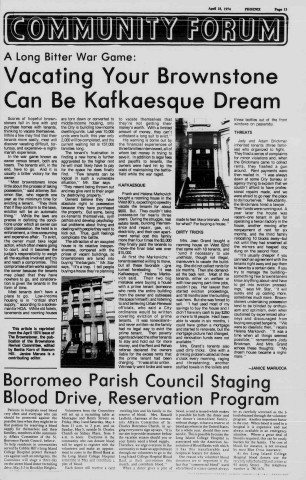
April 18, 1974 PHOENIX Page 13A Long B itter W a r G a m e :V a ca tin g Y o u r B ro w n sto n eC an Be K a fk a e sq u e D reamScores of hopeful brownstoners fall in love with andpurchase homes with tenants,thinking to vacate themselves.W hile a few may find that theirtenants move easily, most willdiscover vacating difficult, torturous, and expensive-a nightmarish experience.In the war game known asowner versus tenant, both arelosers. The tenants will, in theend, have to go. And it isusually a bitter victory for theowner.%u201c Most brownstoners knowlittle about the process of takingpossession,%u201d said attorney Solomon Star, who regards oneyear as the minimum time forevicting a tenant. %u201cThey thinkthat if they conform to the laws,eviction will be an automaticthing.%u201d W hile the laws areprecise in defining the conditions under which an owner canclaim possession, the twist is inenforcement, a time-consumingand expensive affair. To evict,the owner must take legalaction, which often means goingto court, and it becomes thejudge%u2019s responsibility to weighall the equities involved and tryand reach a compromise. Thiscompromise often works againstthe owner because the tenantsmay plead that they havenowhere to go, and consideration is given the tenants in theform of time.Most tenants don%u2019t have aplace to go. Low-incomehousing is in %u201c critical shortsupply,%u201d according to a spokesman for HDA. While old hotels,tenements and rooming housesThis article is reprintedfrom the A pril 1974 issue ofThe Brownstoner, the publication of the BrownstoneRevival Committee, editedby Benita Korn of BoerumH ill. Janice Maruca is acontributing editor.are torn down or converted tomiddle-income housing, onlythe City is building low-incomedwelling units. Last year 10,000units were built; this year only2,000 will be completed, and thecurrent waiting list is 157,000families long.The tenant%u2019s frustration infinding a new home is furtheraggravated by the higher renthe will most likely have to payfor the space he does finallyfind. %u201c Few tenants can belogical in such a vulnerablesituation,%u201d M r. Star says.%u201c They resent being thrown outand may give vent to their angerby destroying property.%u201dOwners believe they haveabsolute right to possessionbecause they have purchasedthe property. But some, beingex-tenants themselves, sympathize and develop psychological problems about living anddealing with people they want tokick out. Thus, guilt feelingscomplicate the battle.The attraction of an occupiedhouse is its relative inexpensiveness, compared with theprices of vacant buildings, sobrownstoners are lured intobuying %u201c thebargain.%u201d Mr. Starsays, %u201c It%u2019s a trap. I tell peoplebuying a house they%u2019re planningto vacate themselves thatth e y%u2019re not getting theirmoney%u2019s worth. With a limitedamount of money, they can%u2019twithstand a long suit to evict.%u201dHis warning is borne out bythe financial experiences ofthree families interviewed, all ofwhom lost money in trying tosave it. In addition to legal feesand payoffs to tenants, theowners were hard hit by thecosts of maintaining the battlefield while the war raged.KAFKAESQUEFrank and Helena Markovichbought a rooming house in theWest 80%u2019s, expecting to speedilyvacate the tenants for about$600. But. They couldn%u2019t takepossession for nearly threeyears. During the struggle, realestate taxes, building maintenance and repair, gas, oil,electricity, and their own apartment rental cost this familymore than four times the $3,000they finally paid the tenants tomove-the final total was over$15,000.At first the M arkoviche'tenants seemed willing to move,but all these favorable '.ignsturned foreboding, %u201c it wasKafkaesque,%u201d Helena Markovich said. Their two bigmistakes were buying a housewith a prime tenant (someonewho rents the entire buildingfrom the owner and subleasesthe space himself); and listeningto and believing Urban Renewalofficials, who said a Cityordinance would be w rittencovering eviction of prim etenants. It was nonexistentand never written-so the familyhad no legal way to evict theprime tenant. Then povertyagents advised the other tenantsto stay and hold out for moremoney, and the Rent and Rehabreferee declared the ownersliable for the excess rents thatthe prime tenant had beencharging. %u201c It was all so unfair.W e nearly went broke and weremade to feel I ike criminals. Andfor what? For buying a house. %u2019 %u2019DIRTY TRICKSMrs. Jean Grand bought arooming house on West 82ndthat came with 18 tenants, andound it necessary to useunethical, though not illegal,maneuvers to vacate the building. She did not collect rents forsix months. Then she demanded the back rent. Most of thetenants, either on welfare orwith low-paying part-time jobs,couldn%u2019t pay. Her lawyer thenstarted eviction proceedings,and 18 months later the buildingwas hers. But she was forced tosell. %u201c I had used most of mysavings to buy the house and Ididn%u2019t have any cash to pay $250or more to 18 people. Had I beenable to vacate in six months, Icould have gotten a mortgageand started to renovate, but themortgage picture had changed,and renovation funds were notavailable.%u201dMrs. Grand%u2019s tenants alsoused dirty tricks. One with adrinking problem called at threeo%u2019clock every morning, ragingand threatening; anotherstuffed towels in the toilets andthrew bottles out of the frontwindows on passersby.THREATSJody and Adam Brickmaninherited tenants (three families) who organized to fight.They filed a series of complaintsfor minor violations and, whenthe Brickmans came to collectrents, they flashed a gunaround. Rent payments werethen mailed in. %u201c I was alwaysdown at some City bureau oragency trying to explain that wecouldn%u2019t afford to have professional repairs made, and wewere afraid to go near the placetodoitourse'ves.%u201d Reluctantly,the Brickmans hired a lawyer.Their funds were running out. Ayear later the house wasvacant-one tenant in jail foroperating a heroin factory in thehouse, another moving afternonpayment of rent for sixmonths, and the third familyrelocating 10 blocks away-butnot until they had smashed allthe mirrors and heaped dogdung on the second floor.%u201c It%u2019s usually cheaper if youcan reach an agreement with thetenants right away and pay themto I eave by a certai n date. I f youtry to manage the buildingsomething few brownstonersknow anything about-and haveto get into eviction proceedings,%u201d says Mr. Star, %u201c it willsurely end up costing more,sometimes much more. Brownstoners undertaking possessiontend to be blinded by enthusiasm and optimism, even whencautioned by experienced attorneys and discouraged frombuying occupied bargains. %u201c Wewere so idealistic then,%u201d recallsHelena Markovich. %u201c It was atime when all things seemedpossible,%u201d remembers JodyBrickman. And Mrs. Grandechoes these thoughts: %u201c Mydream house became a nightmare.%u201d-JA N iC E MARUCCABorromeo Parish CouncilBlood Drive, ReservationPatients in hospitals need blood very often and everyoije who can should be protected against the possible time when they might be in that position by reserving a blood supply for themselves and their families, members of the community Affairs Committee of the St. Borromeo Parish Council, believe. To help residents in communities served by Cobble Hill's Long Island College Hospital protect themselves against such an emergency, theC 1 r - l n o n n l U x n n J n o V .U U U U 1U C C n u t J i u g v a u u w v u u jon-the-street blood donor recruiting drive, May 3-5 in Brooklyn Heights.Volunteers from the Committee will set up a recruiting table at Montague and Henry Streets on Friday, May 3 and Saturday, May 4 from 11 a.m. to 3 p.m. and on Sunday, May 5, outside St. Charles Church on Sidney Place, from 9 a.m. to noon. Everyone in the community who can donate blood will be urged to register with the volunteers and make an appointment to come to the Blood Bank at the Long Island College Hospitali n d n r itriKiitcpint of blood.Each donor will receive a cardentitling him and his family to the reserve of blood. Mrs. Russell Layfield, chairman of the community Affairs Committee of St. Charles Borromeo Church, in urging everyone to sign up says, %u201c it is our aim to provide insurance before the vacation season should you or your family need a blood supply. Therefore, we urge everyone in the community to make an appointment through our volunteers to go to the Long Island College Hospital Blood 5d%u201dR lit their convenience month, and contribute blood.\When a donor gives a pint ofblood, a card is issued which makes it possible for both the donor and the donor%u2019s immediate family, without charge, to have a reserve of blood anywhere in the United States for a whole year, should they ever need it. This is possible because the Long Island College Hospital is associated with the American Association of Blood Banks with which it has this transferrable and reciprocal feature for donors.One reason why volunteer blood donations arc so important is the fact that %u201ccommercial blood\when blood is scarce cannot alwaysStagingProgrambe as carefully screened as the b lood obtained through the volunteer program. Another important factor is the cost. When blood is used in a hospital it is expensive and not always available in an emergency situation. Where a great deal of blood is required, this can be costly burden for the family. The cost of blood, for instance, is not covered by most Blue Cross insurance.At the Long Island College Hospital blood donors use the recently refurbished blood cer#*kf'93 Amity Street. The telephone number is 780-1676.t %u00bb f t t * ,


